Important Notice: Beware of Scams Using the Name "EINPAYS/EINPAYZ"
We have recently discovered that fraudsters are misusing the name EINPAYS/EINPAYZ to deceive traders, service providers, and other individuals by collecting payments through unauthorized channels.
- If you receive any communication claiming to be from EINPAYS/EINPAYZ and asking for payments or sensitive details, we strongly urge you to verify its authenticity first.
- All the official contact details can be found on https://einpays.com or https://einpayz.com
Verify Before You Act:
To confirm whether a communication is genuinely from EINPAYS/EINPAYZ, please email us at [email protected] before making any payments or sharing any personal information.



Become a Partner
Do you want to become a partner
Your name
Fill the form to submit
Your Company name
Fill the form to submit
Your E-mail
Fill the form to submit
Countries
Fill the form to submit
Your phone number (Telegram)
Fill the form to submit
Web-site
Fill the form to submit
Contact person
Fill the form to submit
Business

Message
Fill the form to submit
Become a Partner
Do you want to become a partner
Your name
Fill the form to submit
Your Company name
Fill the form to submit
Your E-mail
Fill the form to submit
Countries
Fill the form to submit
Your phone number (Telegram)
Fill the form to submit
Web-site
Fill the form to submit
Contact person
Fill the form to submit
Business
Message
Fill the form to submit
What is a payment processor and why it matters for your business
- 2026-03-25
In today's digital world, where online payments are becoming the standard, it is crucial for businesses to understand how customer funds are processed. Whether you sell products through an online store, offer subscription-based services, or work with international clients, a key element of a successful financial strategy is choosing the right payment processor.
What is a payment processor?
A payment processor is a service that enables businesses to accept and process digital payments from customers. It acts as an intermediary between the customer's bank and the business's bank, ensuring secure, fast, and transparent movement of money.
When a customer pays for a purchase—whether by debit or credit card, through UPI, internet banking, digital wallet, or a payment link—the payment processor facilitates communication between the banks and payment networks. It verifies the payment details, authorizes the transaction, and transfers the funds to the business's account, often within seconds.
In other words, a payment processor ensures that money coming from customers is securely and promptly credited to your account without delays or errors.
What does a payment processor do?
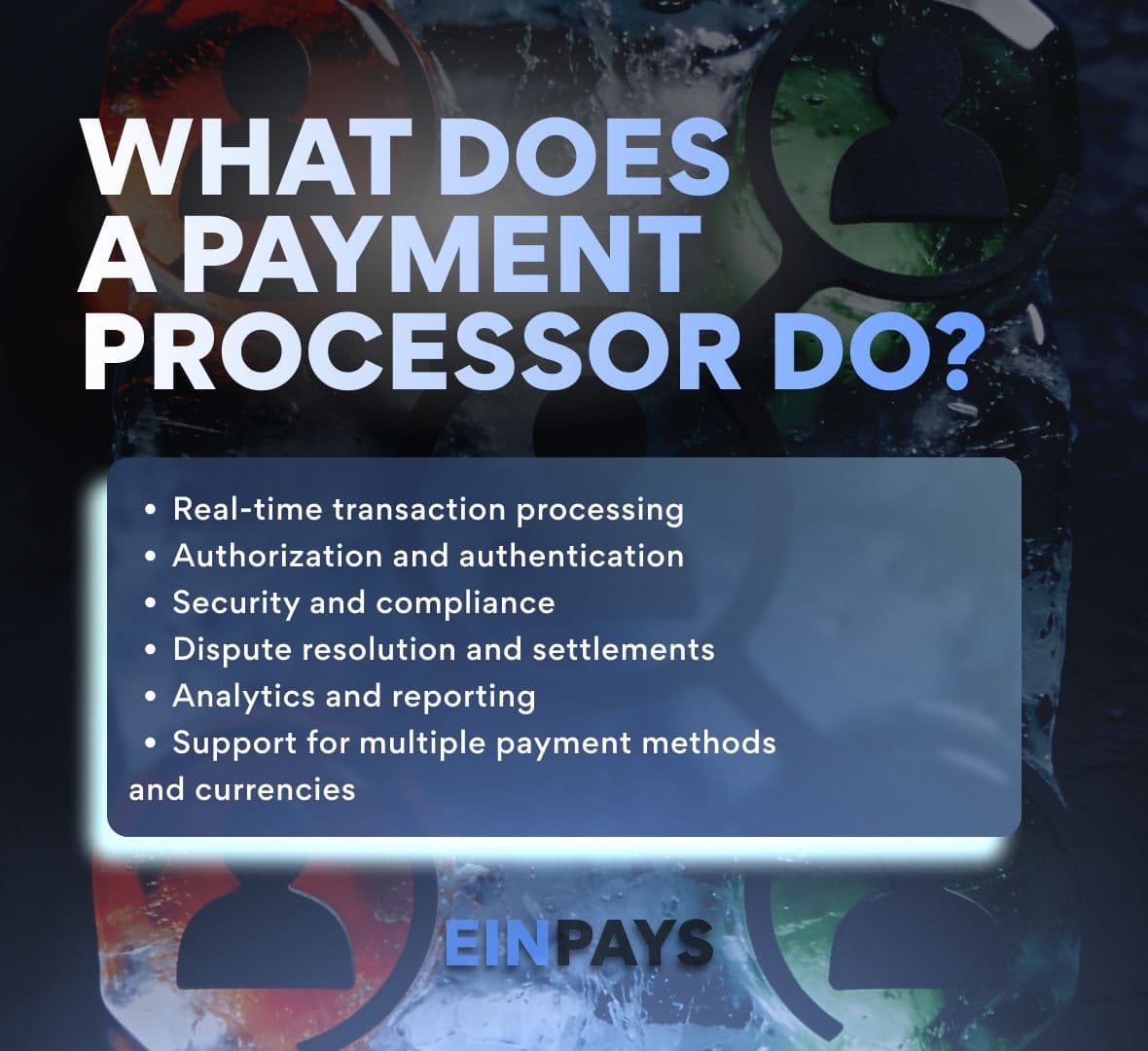
The role of a payment processor extends far beyond simply moving money. It performs several critical functions:
- Real-time transaction processing
When an online payment is made, the processor collects transaction data and securely transmits it to the banks: the customer's bank (issuer) and the business's bank (acquirer).
- Authorization and authentication
The payment processor verifies:
- Whether the customer has sufficient funds in their account;
- Whether the selected payment method is valid;
- Whether the user is authentic.
These steps minimize fraud risk and protect your business.
- Security and compliance
Modern processors use:
- Data encryption to protect information;
- Tokenization, which replaces real data with secure tokens;
- Compliance with international PCI DSS standards for secure data storage and transmission.
- Settlement and payouts
After payment authorization, the processor ensures funds are transferred to the business's account, deducting applicable fees. This typically takes 1–3 business days, depending on the banks involved and the payment type.
- Analytics and reporting
Payment processors provide a real-time dashboard, allowing you to track payments, analyze trends, manage refunds, and reconcile financial transactions.
- Support for multiple payment methods and currencies
A payment processor enables:
- Acceptance of UPI, cards, digital wallets, internet banking, and BNPL;
- Multi-currency payment support for international trade.
How a payment processor works:
-
Customer makes a payment The customer enters their details on a website, in an app, or at a POS terminal.
-
Data encryption The data is converted into a secure code that prevents unauthorized access.
-
Data transmission to the processor The encrypted information is sent to the processor, which forwards it to the acquiring bank.
-
Routing through card networks If a card is used, the transaction goes through Visa or Mastercard and then reaches the issuing bank.
-
Transaction approval by the issuing bank The bank checks for sufficient funds, card validity, and signs of fraud.
-
Response to the business and order fulfillment If the payment is approved, the business receives a signal to complete the sale: shipping the product or delivering the service.
-
Transfer completion and settlement The processor works with the acquiring bank to credit the funds to the business's account.
How to choose a payment processor
Choosing a processor is a strategic decision for any business. Important factors to consider:
- Transparent pricing and fees: choose a partner with no hidden charges;
- Support for popular payment methods: cards, UPI, mobile wallets, BNPL;
- Security and compliance: PCI DSS, encryption, fraud prevention;
- Easy integration: compatibility with your website, app, ERP, or invoicing software;
- Global and multi-currency support: for entering international markets;
- User convenience: a simple interface and management dashboard;
- Customer support: 24/7 assistance across all channels;
- Scalability: the ability to expand functionality as your business grows;
- Flexible terms: no rigid contractual obligations.
Modern platforms such as Einpays combine the functions of a processor and a gateway, providing a complete payment processing cycle within a single solution.
Other News
How digital payments are transforming small business in India in 2026
01.04.2026
How digital payments are transforming small business in India in 2026
Digital payments have ceased to be merely a convenient tool—they have become a growth engine for millions of small businesses across India. In 2026, businesses face a new reality: instant transfers, secure electronic transactions, and seamless integration with digital platforms are now necessities for any entrepreneur who wants to grow their business and build customer trust. Small businesses, from street vendors to local shops, have begun to realize how technology is changing their financial day-to-day operations. Fast payment processing, transparent accounting, and access to credit—all of this is becoming possible through digital systems that allow businesses to operate without a cash register and accelerate cash flow.
What is a payment processor and why it matters for your business
25.03.2026
What is a payment processor and why it matters for your business
In today's digital world, where online payments are becoming the standard, it is crucial for businesses to understand how customer funds are processed. Whether you sell products through an online store, offer subscription-based services, or work with international clients, a key element of a successful financial strategy is choosing the right payment processor.
Tips for effective cash flow management in the digital age
18.03.2026
Tips for effective cash flow management in the digital age
In modern business, the ability to manage cash flow determines how sustainable, flexible, and ready for growth your business will be. Today, as digital technologies are changing the game, effective financial management has become easier and faster, but simultaneously requires new approaches and tools.


Connect global

Sales
Business Development Manager
Partnership
Account Manager
Business Development Manager
Connect global
Sales
Partnership
Account Manager
Business Development Manager
Business Development Manager


Become a Partner
Do you want to become a partner
Your name
Fill the form to submit
Your Company name
Fill the form to submit
Your E-mail
Fill the form to submit
Countries
Fill the form to submit
Your phone number (Telegram)
Fill the form to submit
Web-site
Fill the form to submit
Contact person
Fill the form to submit
Business
Message