Important Notice: Beware of Scams Using the Name "EINPAYS/EINPAYZ"
We have recently discovered that fraudsters are misusing the name EINPAYS/EINPAYZ to deceive traders, service providers, and other individuals by collecting payments through unauthorized channels.
- If you receive any communication claiming to be from EINPAYS/EINPAYZ and asking for payments or sensitive details, we strongly urge you to verify its authenticity first.
- All the official contact details can be found on https://einpays.com or https://einpayz.com
Verify Before You Act:
To confirm whether a communication is genuinely from EINPAYS/EINPAYZ, please email us at [email protected] before making any payments or sharing any personal information.



Become a Partner
Do you want to become a partner
Your name
Fill the form to submit
Your Company name
Fill the form to submit
Your E-mail
Fill the form to submit
Countries
Fill the form to submit
Your phone number (Telegram)
Fill the form to submit
Web-site
Fill the form to submit
Contact person
Fill the form to submit
Business

Message
Fill the form to submit
Become a Partner
Do you want to become a partner
Your name
Fill the form to submit
Your Company name
Fill the form to submit
Your E-mail
Fill the form to submit
Countries
Fill the form to submit
Your phone number (Telegram)
Fill the form to submit
Web-site
Fill the form to submit
Contact person
Fill the form to submit
Business
Message
Fill the form to submit
Blog
What is a NACH Mandate and what are its key benefits?
07.10.2026
What is a NACH Mandate and what are its key benefits?
Recurring payments — subscriptions, insurance premiums, loan repayments, utility bills, and other regular expenses — require funds to be collected on time. For customers, this means remembering payment dates; for businesses, it means processing a large number of transactions on a regular basis. In India, NACH (National Automated Clearing House) is used to automate such payments. It is a system developed by the NPCI (National Payments Corporation of India) that enables bulk electronic debit and credit transactions between bank accounts. One of the key tools within this system is the NACH Mandate — an electronic authorization that allows a customer to make recurring payments directly from their bank account.
EINPAYS at Forex Expo Dubai 2026!
30.09.2026
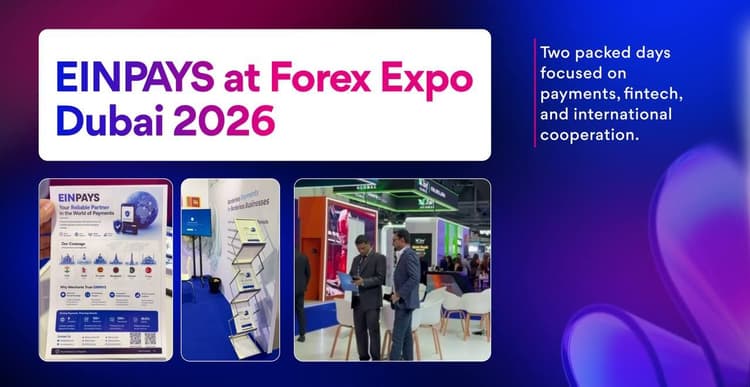
EINPAYS at Forex Expo Dubai 2026!
Forex Expo Dubai 2026 has come to an end — and we’re sharing the key highlights from EINPAYS’ participation in one of the notable international events for the forex, fintech, payments, and financial industries. Over two busy days at the Dubai World Trade Centre, the EINPAYS team met with brokers, fintech companies, payment providers, IBs, affiliates, and other representatives of the international market. •Discussed current trends in payments and financial infrastructure •Met potential partners and explored opportunities for collaboration •Exchanged insights on international payments and business payouts •Discussed how to make payment processes faster, simpler, and more efficient •Presented EINPAYS solutions for fast and secure payment processing
Crypto acquiring: a solution or a new headache?
23.09.2026
Crypto acquiring: a solution or a new headache?
Cryptocurrency is used for more than just investing. Today, digital assets are also used for transfers, international settlements, and payments for goods and services. For businesses, this creates new opportunities while also introducing additional risks. That is why crypto acquiring should not be viewed as a universal solution, but rather as a tool that needs to fit a specific business model.
What is settlement: payment cycles and settlement timelines
16.09.2026
What is settlement: payment cycles and settlement timelines
A customer has paid for an order and received a “Payment successful” message, but the merchant still doesn’t see the funds in their bank account. This doesn’t necessarily mean there is an error. A successful payment and the actual receipt of funds are two different stages. Between them come processing, verification, clearing, and settlement — the process of settling the payment. Understanding this process helps businesses manage cash flow, reconcile orders, and know when funds actually become available.

How digital payments help Indian businesses grow online
09.09.2026
How digital payments help Indian businesses grow online
Indian businesses are rapidly moving into the digital space. Companies sell through websites, mobile apps, social media, messaging platforms, and marketplaces. For businesses, this creates an opportunity to reach customers far beyond their local region. But online sales are impossible without convenient payment options. If a customer cannot complete a purchase quickly and securely using their preferred payment method, a company risks losing that customer before the order is even placed. That’s why payment infrastructure is becoming more than just a technical tool — it is now part of a company’s growth strategy.
Why companies accept payments in monero (XMR) in 2026
03.09.2026
Why companies accept payments in monero (XMR) in 2026
Crypto payments are becoming part of international business infrastructure. But convenience also raises a privacy question: in Bitcoin, Ethereum, and most public blockchains, transactions can be traced. Monero (XMR) takes a different approach — privacy is built directly into the protocol. For businesses, this can be particularly relevant for cross-border B2B settlements, digital services, and working with customers who value privacy.
Crypto portfolio has dropped significantly: what to do step by step
26.08.2026
Crypto portfolio has dropped significantly: what to do step by step
A sharp crypto market decline can easily trigger the urge to do something immediately: sell everything or, on the contrary, buy even more. But the first thing to do after a major drop is not make a trade, but pause and analyze. It is important to understand the reason for the decline, assess the condition of your assets, and determine whether the current level of risk is consistent with your financial situation. In short: first, assess the current state of your portfolio, identify the reason for the decline, review your financial obligations, and only then decide whether to leave things unchanged, reduce risk, or gradually increase your position.
Why storing all your cryptocurrency in one place is risky
18.08.2026
Why storing all your cryptocurrency in one place is risky
One account, one wallet, and one balance — it’s convenient. You don’t need to remember multiple addresses, switch between services, or search for a specific asset. But this convenience can become a serious risk. If all assets depend on one password, one seed phrase, one device, or one platform, any mistake can lead to losing access to the entire portfolio. The main issue is not a specific wallet or exchange — it is creating a single point of failure. Research shows that human error remains one of the biggest threats in the crypto industry: loss of access, transaction mistakes, and unsafe data storage are among the most common reasons for asset losses. At the same time, the number of cryptocurrency users has already exceeded 500 million people, making reliable payment infrastructure a critical part of the digital economy.
Subscription payment challenges in India: how global companies can adapt their payment processes
12.08.2026
Subscription payment challenges in India: how global companies can adapt their payment processes
India is one of the fastest-growing subscription economies. More than 900 million internet users, rapid growth in OTT, SaaS, EdTech, and D2C brands make this market incredibly attractive for global companies. But there’s one problem. What works in the US or Europe doesn’t necessarily work in India. Low credit card usage, the dominance of UPI, strict Reserve Bank of India (RBI) requirements, and a fragmented payment ecosystem make subscription billing a real challenge.


Connect global

Sales
Business Development Manager
Partnership
Account Manager
Business Development Manager
Connect global
Sales
Partnership
Account Manager
Business Development Manager
Business Development Manager


Become a Partner
Do you want to become a partner
Your name
Fill the form to submit
Your Company name
Fill the form to submit
Your E-mail
Fill the form to submit
Countries
Fill the form to submit
Your phone number (Telegram)
Fill the form to submit
Web-site
Fill the form to submit
Contact person
Fill the form to submit
Business
Message