Important Notice: Beware of Scams Using the Name "EINPAYS/EINPAYZ"
We have recently discovered that fraudsters are misusing the name EINPAYS/EINPAYZ to deceive traders, service providers, and other individuals by collecting payments through unauthorized channels.
- If you receive any communication claiming to be from EINPAYS/EINPAYZ and asking for payments or sensitive details, we strongly urge you to verify its authenticity first.
- All the official contact details can be found on https://einpays.com or https://einpayz.com
Verify Before You Act:
To confirm whether a communication is genuinely from EINPAYS/EINPAYZ, please email us at [email protected] before making any payments or sharing any personal information.



Become a Partner
Do you want to become a partner
Your name
Fill the form to submit
Your Company name
Fill the form to submit
Your E-mail
Fill the form to submit
Countries
Fill the form to submit
Your phone number (Telegram)
Fill the form to submit
Web-site
Fill the form to submit
Contact person
Fill the form to submit
Business

Message
Fill the form to submit
Become a Partner
Do you want to become a partner
Your name
Fill the form to submit
Your Company name
Fill the form to submit
Your E-mail
Fill the form to submit
Countries
Fill the form to submit
Your phone number (Telegram)
Fill the form to submit
Web-site
Fill the form to submit
Contact person
Fill the form to submit
Business
Message
Fill the form to submit
Do you need to pay GST for online sales in India? Rules, limits, and understanding TCS
- 2026-05-13
India’s e-commerce market is growing rapidly. But alongside the rise of online sales comes a key question: do businesses need to pay GST when selling goods and services online? The short answer: it depends on the sales model. If a seller operates through a marketplace, GST registration is usually required from the very beginning. If sales are made through a personal website, standard turnover thresholds may apply: ₹40 lakh for goods and ₹20 lakh for services in most Indian states. These thresholds are confirmed by GST Council guidelines and GST tax reference materials. For online businesses, this is far more than a formality. GST affects marketplace access, tax calculations, TCS deductions, refunds, reporting obligations, and overall cash flow. That is why sellers should understand the rules before making their first sale.
When GST becomes mandatory for online sellers
The key rule is simple: it is not only about how much you sell, but also where you sell.
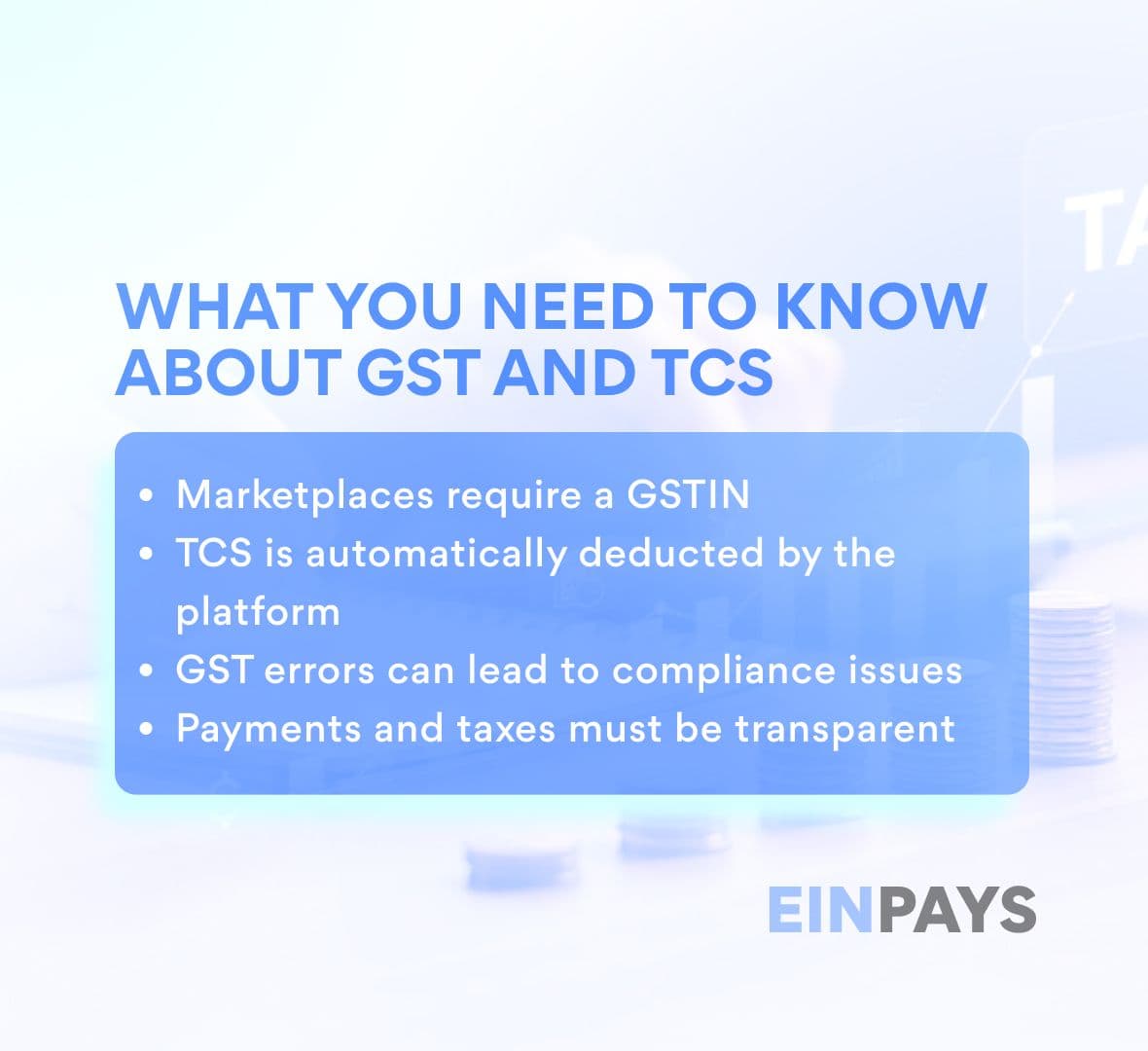
If a seller lists products on marketplaces, they usually need a GSTIN (GST registration number). This is because supplies made through an e-commerce operator fall under special provisions of the CGST Act, including mandatory GST registration for marketplace sellers.
If a business sells only through its own website, then normal GST thresholds apply:
- up to ₹40 lakh turnover for goods in most states
- up to ₹20 lakh turnover for services Some states have lower thresholds.
Why marketplaces require GSTIN
Marketplaces do more than simply help businesses sell products. Under Indian law, they are part of the tax chain and must comply with specific compliance requirements. One of the main reasons is TCS (Tax Collected at Source). This is a tax that the e-commerce operator deducts from the seller’s net sales value and remits to the government.
Section 52 of the CGST Act requires marketplace operators to file reports regarding supplies and TCS amounts.
Without a GSTIN, the platform cannot properly:
- identify the seller
- deduct and report TCS
- transfer information to the tax system
- link sales to the seller’s tax account
That is why for most marketplaces, GSTIN is not optional — it is both a technical and legal requirement.
What is TCS in simple terms
TCS is a mechanism where the marketplace withholds a small percentage from a seller’s sales and reflects it within the GST system.
For sellers, TCS does not necessarily mean losing additional money. The deducted amount can later be claimed as a tax credit when filing GST returns.
However, there is an important nuance: if a seller does not maintain records, reconcile marketplace reports, or file tax returns properly, TCS can become a source of confusion, errors, and overpayments.
Personal websites: when GST may not be required immediately
If a seller operates through their own online store instead of a marketplace, the rules are more flexible.
For example, a small D2C brand selling products through its own website and delivering orders within a single state may not require GST registration until the turnover threshold is exceeded.
But as the business grows, several risk factors appear: interstate sales
- expansion to marketplaces
- adding new product categories
- turnover exceeding the threshold
- providing taxable services
It is important to understand: having your own website does not permanently exempt a business from GST. It only allows businesses to operate without registration up to a certain point, provided no other mandatory registration conditions apply.
The most common mistakes online sellers make
Many sellers launch businesses quickly: they create a website, connect payments, run ads — and only later think about taxes. This is a risky approach.
The most common mistakes include:
- joining marketplaces without understanding GST rules
- failing to distinguish intra-state and inter-state sales
- not reconciling TCS with marketplace reports
- forgetting to file nil returns
- mixing personal and business payments
- ignoring refunds when calculating taxable turnover
Indian tax authorities are increasingly using digital data — including UPI transactions — to identify unregistered sellers who exceed GST thresholds. This highlights an important trend: online and digital sales are becoming far more transparent to tax authorities.
What businesses must do after GST registration
Registration is only the first step.
After obtaining a GSTIN, sellers must regularly fulfill tax obligations.
This usually includes:
- filing GSTR-1 with sales details
- filing GSTR-3B with tax liability calculations
- reconciling TCS with marketplace reports
- managing input tax credit (ITC)
- tracking refunds and adjustments
Even if there were no sales during the month, many businesses are still required to file nil returns.
This is a detail that many new sellers overlook.
For e-commerce businesses, reconciliation is especially important: marketplace reports, actual payouts, refunds, commissions, and tax records must all match.
Failure to reconcile these properly may result in discrepancies, payout holds, or tax inquiries.
Why payment infrastructure matters for GST compliance
For online sellers, payments and taxes are directly connected.
If payments are processed chaotically, it becomes difficult to track turnover, refunds, commissions, TCS deductions, and tax credits.
That is why modern e-commerce businesses need not only sales, but also transparent payment infrastructure.
A reliable payment system helps businesses:
- accept payments faster
- monitor cash flow
- reduce reconciliation errors
- control refunds
- simplify reporting processes
In 2026, India’s e-commerce ecosystem is becoming more mature, regulated, and technology-driven.
The businesses that succeed are those that build transparent tax, payment, and operational systems from the start.
This is where fintech solutions become a critical part of business infrastructure.
With solutions from Einpays, businesses gain fast, secure, and convenient payment tools that help sellers operate more transparently, efficiently, and confidently in India’s rapidly evolving digital economy.
Other News
What Is a Cryptocurrency Swap and how to start exchanging without unnecessary complications?
27.05.2026
What Is a Cryptocurrency Swap and how to start exchanging without unnecessary complications?
The cryptocurrency market is evolving rapidly, and with it, the ways of managing digital assets are changing as well. Today, users no longer need to go through complex and costly chains of operations to exchange one coin for another. A faster and more flexible tool has replaced the traditional model — the cryptocurrency swap. A swap allows users to instantly exchange digital assets within the blockchain ecosystem, without involving banks or converting funds into fiat currency. This makes the process not only faster but also significantly more cost-effective. For users, this opens up new opportunities: participating in various projects, optimizing investment portfolios, and reacting quickly to market changes.
Sales through personal branding: how experts and online businesses can accept more payments
20.05.2026
Sales through personal branding: how experts and online businesses can accept more payments
In 2026, personal branding has become one of the most powerful tools for online sales. People no longer buy only a product or service — they buy trust, reputation, and expertise. That is why freelancers, consultants, digital specialists, owners of online schools, iGaming projects, high-risk platforms, and e-commerce businesses are increasingly building sales around their personal identity or company brand. However, even a strong personal brand does not guarantee stable revenue if a business lacks a well-structured sales system and convenient payment infrastructure. A user may become interested in a product but abandon the purchase due to complicated payment flows, slow transaction confirmation, or the absence of familiar payment methods. Today, it is not enough for online businesses to simply attract an audience — they must also turn attention into fast and secure payments.

Do you need to pay GST for online sales in India? Rules, limits, and understanding TCS
13.05.2026
Do you need to pay GST for online sales in India? Rules, limits, and understanding TCS
India’s e-commerce market is growing rapidly. But alongside the rise of online sales comes a key question: do businesses need to pay GST when selling goods and services online? The short answer: it depends on the sales model. If a seller operates through a marketplace, GST registration is usually required from the very beginning. If sales are made through a personal website, standard turnover thresholds may apply: ₹40 lakh for goods and ₹20 lakh for services in most Indian states. These thresholds are confirmed by GST Council guidelines and GST tax reference materials. For online businesses, this is far more than a formality. GST affects marketplace access, tax calculations, TCS deductions, refunds, reporting obligations, and overall cash flow. That is why sellers should understand the rules before making their first sale.


Connect global

Sales
Business Development Manager
Partnership
Account Manager
Business Development Manager
Connect global
Sales
Partnership
Account Manager
Business Development Manager
Business Development Manager


Become a Partner
Do you want to become a partner
Your name
Fill the form to submit
Your Company name
Fill the form to submit
Your E-mail
Fill the form to submit
Countries
Fill the form to submit
Your phone number (Telegram)
Fill the form to submit
Web-site
Fill the form to submit
Contact person
Fill the form to submit
Business
Message