Important Notice: Beware of Scams Using the Name "EINPAYS/EINPAYZ"
We have recently discovered that fraudsters are misusing the name EINPAYS/EINPAYZ to deceive traders, service providers, and other individuals by collecting payments through unauthorized channels.
- If you receive any communication claiming to be from EINPAYS/EINPAYZ and asking for payments or sensitive details, we strongly urge you to verify its authenticity first.
- All the official contact details can be found on https://einpays.com or https://einpayz.com
Verify Before You Act:
To confirm whether a communication is genuinely from EINPAYS/EINPAYZ, please email us at [email protected] before making any payments or sharing any personal information.



Become a Partner
Do you want to become a partner
Your name
Fill the form to submit
Your Company name
Fill the form to submit
Your E-mail
Fill the form to submit
Countries
Fill the form to submit
Your phone number (Telegram)
Fill the form to submit
Web-site
Fill the form to submit
Contact person
Fill the form to submit
Business

Message
Fill the form to submit
Become a Partner
Do you want to become a partner
Your name
Fill the form to submit
Your Company name
Fill the form to submit
Your E-mail
Fill the form to submit
Countries
Fill the form to submit
Your phone number (Telegram)
Fill the form to submit
Web-site
Fill the form to submit
Contact person
Fill the form to submit
Business
Message
Fill the form to submit
What is an ARN (Acquirer Reference Number)? A business guide
- 2026-07-15
As digital payments become faster and more transparent, businesses need more than just the ability to accept payments—they also need to understand how to track the movement of funds. When a customer says the payment has already been debited but the business has not yet received it, one of the most important tools for resolving the issue is the ARN. Many businesses encounter this term for the first time while searching for a missing payment or processing a refund. However, understanding what an ARN is and how it works can help resolve disputes more quickly, reduce the workload on customer support teams, and improve payment operations.
What is an ARN?
An ARN (Acquirer Reference Number) is a unique banking transaction identifier assigned to a card payment after it has been successfully processed by the acquiring bank.
Simply put, an ARN acts as a tracking number for a card payment. It allows banks participating in the payment process to locate a specific transaction within the international card payment network.
An ARN typically consists of 23 digits, although the exact format may vary slightly depending on the payment network and acquiring bank. It is important to note that an ARN is not:
- an order number;
- a payment gateway transaction ID;
- a customer's bank reference number.
It is a separate identifier used exclusively within the banking infrastructure.
When is an ARN generated?
An ARN is generated after a card payment has been successfully authorized and forwarded for further processing.
A typical payment flow looks like this:
- The customer pays for a product or service.
- The payment is authorized.
- The acquiring bank submits the transaction to the payment network.
- The transaction receives a unique ARN.
- Funds are settled between the participating banks.
If a transaction is declined during the authorization stage, an ARN is generally not generated.
Why is an ARN important for businesses?
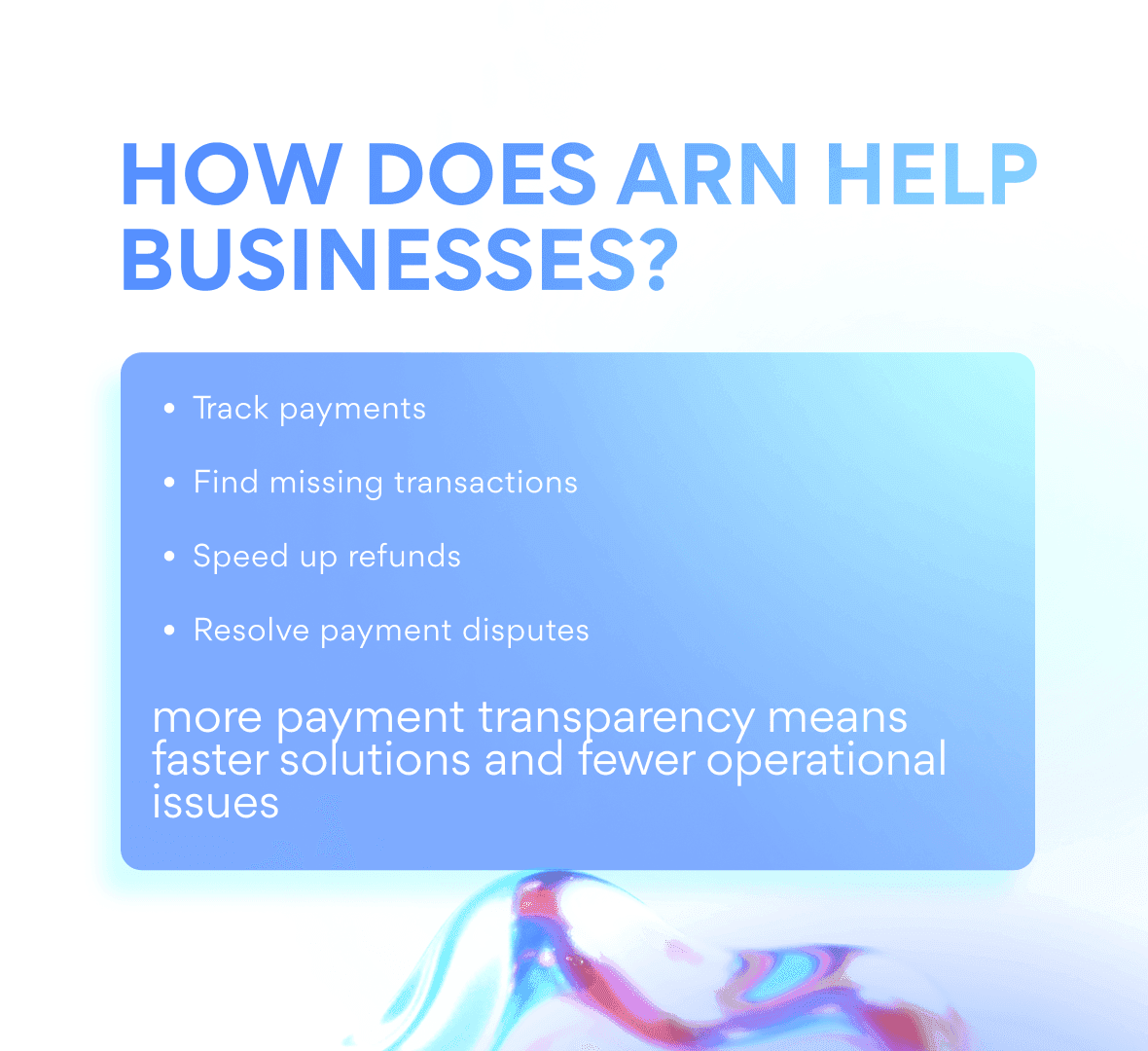
Tracking payments For example, a customer claims that the funds have already been debited, but the merchant has not received the payment.
In this case, the ARN allows the bank to quickly determine:
- the payment status;
- where the transaction is currently located;
- whether settlement has been completed;
- whether there has been a delay between banks.
Tracking refunds If a customer reports that a refund has not been received, the bank can use the ARN to verify the refund transaction and locate the funds much more quickly.
Resolving payment disputes During payment investigations, the ARN serves as the primary transaction identifier.
It helps:
- confirm that the payment was processed;
- identify the payment route;
- verify processing timelines;
- determine where a delay occurred.
ARN vs. Transaction ID: What's the difference?
These terms are often confused, but they serve different purposes.
A Transaction ID is generated by the payment gateway or merchant and is used within the company's payment system.
An ARN, on the other hand, is generated by the acquiring bank after the payment has been processed and is used by banks to track the movement of funds between financial institutions.
This is why a bank's support team will typically request the ARN rather than the payment provider's internal transaction ID.
Where can you find an ARN?
An ARN usually becomes available after the payment has completed processing.
It can typically be obtained through:
- your payment provider's merchant dashboard;
- your acquiring bank;
- your payment service provider's support team;
- in some cases, your merchant bank.
Keep in mind that the ARN is generally not available immediately after payment. It usually appears once the transaction has entered the clearing and settlement stage.
Why is ARN especially important for international payments?
For businesses serving international customers, the ARN is one of the most valuable tools for payment tracking.
Cross-border transactions often pass through multiple banks and payment networks. If a delay occurs, the ARN helps identify exactly where the transaction is within the payment chain.
This is particularly important for:
- e-commerce businesses;
- SaaS companies;
- digital service providers;
- subscription-based platforms;
- international marketplaces;
- high-risk businesses.
The greater the volume of international transactions, the more valuable accurate transaction tracking becomes.
Common mistakes when working with ARNs
Businesses frequently encounter the following issues:
- using a Transaction ID instead of an ARN when contacting a bank;
- expecting an ARN to be generated immediately after payment;
- failing to retain transaction records;
- providing customers with the wrong reference number for payment tracking.
These mistakes increase the time required to resolve payment issues and place additional pressure on customer support teams.
Best practices for managing payment identifiers
To reduce payment tracking issues, businesses should:
- use a payment infrastructure that provides transparent transaction tracking;
- maintain a complete history of payment records;
- keep customers informed about the current payment status;
- automate refund request processing;
- ensure quick access to transaction data.
The easier it is to retrieve payment information, the faster customer inquiries can be resolved and the greater the trust customers place in your business. For modern businesses—especially those processing large volumes of online and international payments —understanding the role of the ARN is an essential part of effective payment infrastructure management.
That's why Einpays helps businesses build transparent, secure, and efficient payment ecosystems, providing reliable transaction processing and complete visibility into the movement of funds.
Other News
Crypto portfolio has dropped significantly: what to do step by step
26.08.2026
Crypto portfolio has dropped significantly: what to do step by step
A sharp crypto market decline can easily trigger the urge to do something immediately: sell everything or, on the contrary, buy even more. But the first thing to do after a major drop is not make a trade, but pause and analyze. It is important to understand the reason for the decline, assess the condition of your assets, and determine whether the current level of risk is consistent with your financial situation. In short: first, assess the current state of your portfolio, identify the reason for the decline, review your financial obligations, and only then decide whether to leave things unchanged, reduce risk, or gradually increase your position.
Why storing all your cryptocurrency in one place is risky
18.08.2026
Why storing all your cryptocurrency in one place is risky
One account, one wallet, and one balance — it’s convenient. You don’t need to remember multiple addresses, switch between services, or search for a specific asset. But this convenience can become a serious risk. If all assets depend on one password, one seed phrase, one device, or one platform, any mistake can lead to losing access to the entire portfolio. The main issue is not a specific wallet or exchange — it is creating a single point of failure. Research shows that human error remains one of the biggest threats in the crypto industry: loss of access, transaction mistakes, and unsafe data storage are among the most common reasons for asset losses. At the same time, the number of cryptocurrency users has already exceeded 500 million people, making reliable payment infrastructure a critical part of the digital economy.
Subscription payment challenges in India: how global companies can adapt their payment processes
12.08.2026
Subscription payment challenges in India: how global companies can adapt their payment processes
India is one of the fastest-growing subscription economies. More than 900 million internet users, rapid growth in OTT, SaaS, EdTech, and D2C brands make this market incredibly attractive for global companies. But there’s one problem. What works in the US or Europe doesn’t necessarily work in India. Low credit card usage, the dominance of UPI, strict Reserve Bank of India (RBI) requirements, and a fragmented payment ecosystem make subscription billing a real challenge.


Connect global

Sales
Business Development Manager
Partnership
Account Manager
Business Development Manager
Connect global
Sales
Partnership
Account Manager
Business Development Manager
Business Development Manager


Become a Partner
Do you want to become a partner
Your name
Fill the form to submit
Your Company name
Fill the form to submit
Your E-mail
Fill the form to submit
Countries
Fill the form to submit
Your phone number (Telegram)
Fill the form to submit
Web-site
Fill the form to submit
Contact person
Fill the form to submit
Business
Message