Important Notice: Beware of Scams Using the Name "EINPAYS/EINPAYZ"
We have recently discovered that fraudsters are misusing the name EINPAYS/EINPAYZ to deceive traders, service providers, and other individuals by collecting payments through unauthorized channels.
- If you receive any communication claiming to be from EINPAYS/EINPAYZ and asking for payments or sensitive details, we strongly urge you to verify its authenticity first.
- All the official contact details can be found on https://einpays.com or https://einpayz.com
Verify Before You Act:
To confirm whether a communication is genuinely from EINPAYS/EINPAYZ, please email us at [email protected] before making any payments or sharing any personal information.



Become a Partner
Do you want to become a partner
Your name
Fill the form to submit
Your Company name
Fill the form to submit
Your E-mail
Fill the form to submit
Countries
Fill the form to submit
Your phone number (Telegram)
Fill the form to submit
Web-site
Fill the form to submit
Contact person
Fill the form to submit
Business

Message
Fill the form to submit
Become a Partner
Do you want to become a partner
Your name
Fill the form to submit
Your Company name
Fill the form to submit
Your E-mail
Fill the form to submit
Countries
Fill the form to submit
Your phone number (Telegram)
Fill the form to submit
Web-site
Fill the form to submit
Contact person
Fill the form to submit
Business
Message
Fill the form to submit
Subscription payment challenges in India: how global companies can adapt their payment processes
- 2026-08-12
India is one of the fastest-growing subscription economies. More than 900 million internet users, rapid growth in OTT, SaaS, EdTech, and D2C brands make this market incredibly attractive for global companies. But there’s one problem. What works in the US or Europe doesn’t necessarily work in India. Low credit card usage, the dominance of UPI, strict Reserve Bank of India (RBI) requirements, and a fragmented payment ecosystem make subscription billing a real challenge.
Why do global companies face payment challenges?
Indian consumers spread their spending across UPI, debit and credit cards, internet banking, and digital wallets.
Four structural factors make recurring billing particularly challenging:
- Low credit card adoption Debit cards and UPI are much more widely used. Global models built primarily around credit cards are not well suited to the Indian market.
- Strict RBI authentication requirements Issuers are required to send notifications 24 hours before a recurring charge. Additional authentication (AFA) is required for transactions above the applicable threshold.
- Inconsistent approval rates Some banks have low auto-debit approval rates, making renewal performance unpredictable.
- Cross-border transaction challenges Transactions processed in US dollars may face higher decline rates than transactions processed in the local currency.
The most common payment issues
Subscription renewal failures. A payment may fail due to insufficient funds, bank restrictions, or card-related issues. If the system doesn’t offer a retry or an alternative payment method, the subscription may be lost. OTP and additional authentication. Some transactions require additional confirmation. If users encounter an extra step or fail to receive the code on time, the likelihood of completing the payment decreases. Payment mandate expiration. Recurring payments rely on the customer’s prior authorization. If the mandate expires or requires an update, the next payment will fail. Cross-border payments. For international companies, charging customers in a foreign currency can be more complicated than processing a local transaction, potentially increasing decline rates. Limited payment method selection. If a service only accepts bank cards, it may lose customers who are accustomed to paying through UPI or other local payment methods. Complex payment reconciliation. When a company uses multiple payment channels, matching transactions, subscriptions, and incoming payments becomes more difficult. Without automation, this increases the workload for the finance team.
How to make subscription payments more reliable
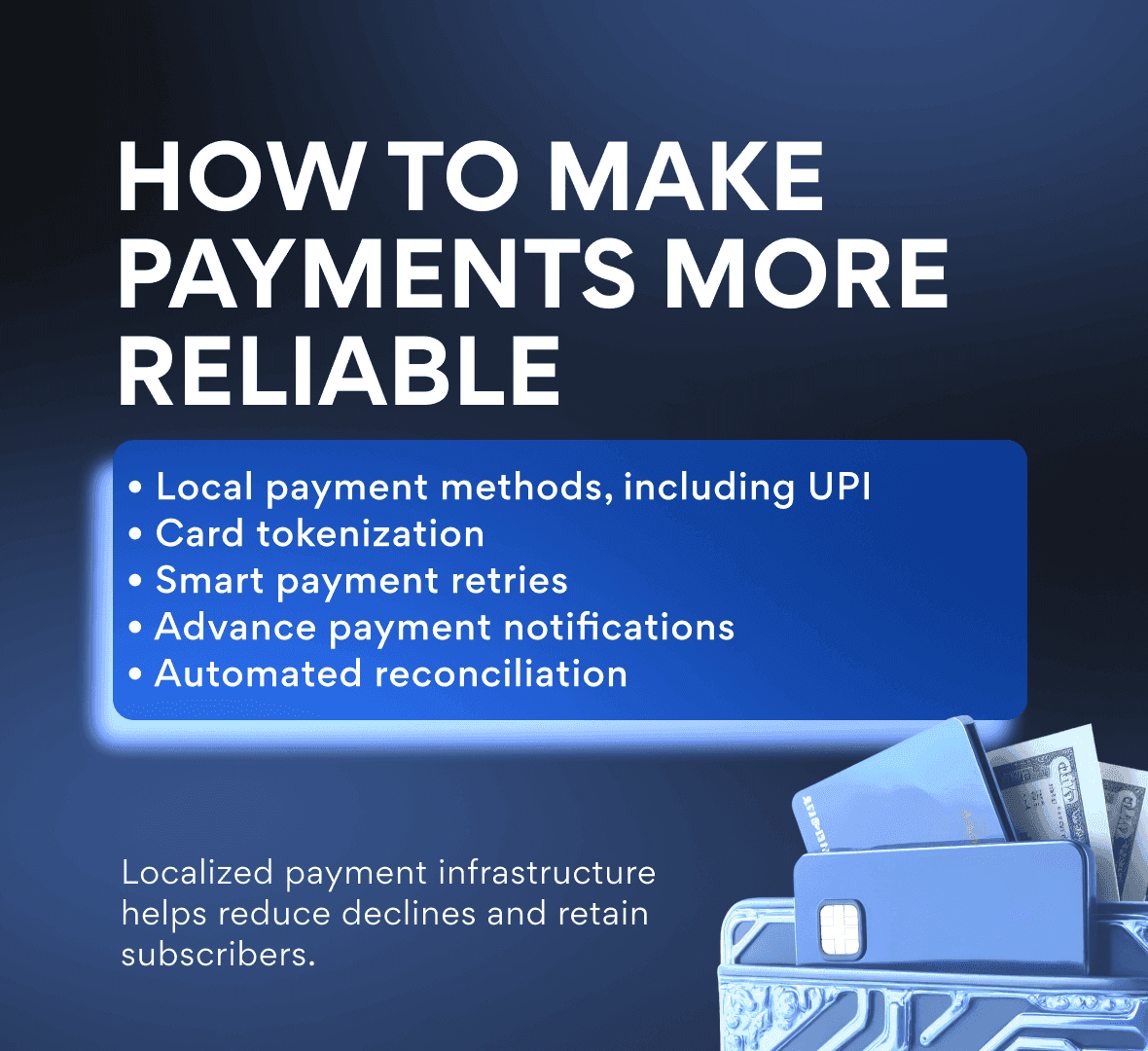
The first step is to localize your payment infrastructure. For the Indian market, it is important to support not only cards but also popular local payment methods, including UPI.
Second, use card tokenization. This allows businesses to securely work with payment credentials without storing the original card details and helps create a more reliable recurring payment process.
Third, implement smart payment retries. When a payment is declined, the customer shouldn’t immediately be considered lost. The decline reason should determine the next step: retry the transaction later, offer another payment method, or ask the customer to update their payment details.
Fourth, notify customers about upcoming charges in advance. Clear notifications help prevent unexpected payment failures while also helping businesses comply with local regulatory requirements.
Fifth, automate payment reconciliation. All payments, refunds, and recurring charges should be accurately reflected in a single system. This reduces manual work and makes it easier to identify errors.
Why payment infrastructure affects customer retention
In a subscription business model, payment is part of the customer experience. Even a satisfied user may cancel a service if their renewal fails multiple times. An effective system should automatically detect the issue, send a notification, retry the payment, and offer an alternative payment method when necessary. This reduces unnecessary friction and helps retain customers.
How to choose a payment solution for the Indian market
It is important to consider more than just transaction fees. Key factors include support for local payment methods, transaction reliability, security, automation, and reporting. For international companies, it is especially important to choose a solution that supports multiple markets and allows the payment process to be adapted to local requirements. The Indian market offers huge opportunities for global subscription services, but it requires a localized approach to payments. To reduce payment declines and retain customers, companies need to account for the popularity of UPI, the specifics of recurring payments, regulatory requirements, and diverse payment preferences.
EinPays helps international companies enter the Indian market without the headache and revenue losses.
Other News
What is a NACH Mandate and what are its key benefits?
07.10.2026
What is a NACH Mandate and what are its key benefits?
Recurring payments — subscriptions, insurance premiums, loan repayments, utility bills, and other regular expenses — require funds to be collected on time. For customers, this means remembering payment dates; for businesses, it means processing a large number of transactions on a regular basis. In India, NACH (National Automated Clearing House) is used to automate such payments. It is a system developed by the NPCI (National Payments Corporation of India) that enables bulk electronic debit and credit transactions between bank accounts. One of the key tools within this system is the NACH Mandate — an electronic authorization that allows a customer to make recurring payments directly from their bank account.
EINPAYS at Forex Expo Dubai 2026!
30.09.2026
EINPAYS at Forex Expo Dubai 2026!
Forex Expo Dubai 2026 has come to an end — and we’re sharing the key highlights from EINPAYS’ participation in one of the notable international events for the forex, fintech, payments, and financial industries. Over two busy days at the Dubai World Trade Centre, the EINPAYS team met with brokers, fintech companies, payment providers, IBs, affiliates, and other representatives of the international market. •Discussed current trends in payments and financial infrastructure •Met potential partners and explored opportunities for collaboration •Exchanged insights on international payments and business payouts •Discussed how to make payment processes faster, simpler, and more efficient •Presented EINPAYS solutions for fast and secure payment processing

Crypto acquiring: a solution or a new headache?
23.09.2026
Crypto acquiring: a solution or a new headache?
Cryptocurrency is used for more than just investing. Today, digital assets are also used for transfers, international settlements, and payments for goods and services. For businesses, this creates new opportunities while also introducing additional risks. That is why crypto acquiring should not be viewed as a universal solution, but rather as a tool that needs to fit a specific business model.


Connect global

Sales
Business Development Manager
Partnership
Account Manager
Business Development Manager
Connect global
Sales
Partnership
Account Manager
Business Development Manager
Business Development Manager


Become a Partner
Do you want to become a partner
Your name
Fill the form to submit
Your Company name
Fill the form to submit
Your E-mail
Fill the form to submit
Countries
Fill the form to submit
Your phone number (Telegram)
Fill the form to submit
Web-site
Fill the form to submit
Contact person
Fill the form to submit
Business
Message