Important Notice: Beware of Scams Using the Name "EINPAYS/EINPAYZ"
We have recently discovered that fraudsters are misusing the name EINPAYS/EINPAYZ to deceive traders, service providers, and other individuals by collecting payments through unauthorized channels.
- If you receive any communication claiming to be from EINPAYS/EINPAYZ and asking for payments or sensitive details, we strongly urge you to verify its authenticity first.
- All the official contact details can be found on https://einpays.com or https://einpayz.com
Verify Before You Act:
To confirm whether a communication is genuinely from EINPAYS/EINPAYZ, please email us at [email protected] before making any payments or sharing any personal information.



Become a Partner
Do you want to become a partner
Your name
Fill the form to submit
Your Company name
Fill the form to submit
Your E-mail
Fill the form to submit
Countries
Fill the form to submit
Your phone number (Telegram)
Fill the form to submit
Web-site
Fill the form to submit
Contact person
Fill the form to submit
Business

Message
Fill the form to submit
Become a Partner
Do you want to become a partner
Your name
Fill the form to submit
Your Company name
Fill the form to submit
Your E-mail
Fill the form to submit
Countries
Fill the form to submit
Your phone number (Telegram)
Fill the form to submit
Web-site
Fill the form to submit
Contact person
Fill the form to submit
Business
Message
Fill the form to submit
Why storing all your cryptocurrency in one place is risky
- 2026-08-18
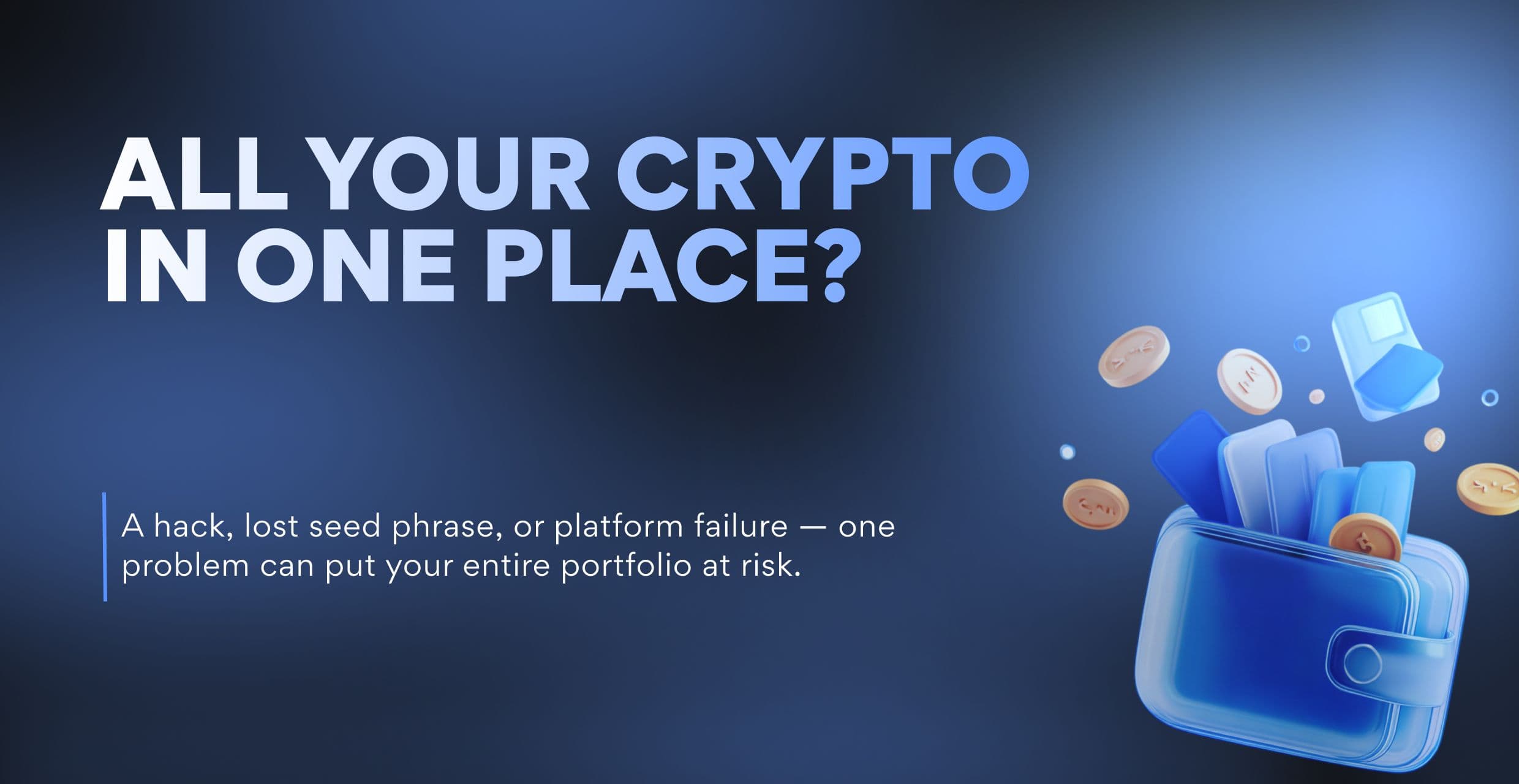
One account, one wallet, and one balance — it’s convenient. You don’t need to remember multiple addresses, switch between services, or search for a specific asset. But this convenience can become a serious risk. If all assets depend on one password, one seed phrase, one device, or one platform, any mistake can lead to losing access to the entire portfolio. The main issue is not a specific wallet or exchange — it is creating a single point of failure. Research shows that human error remains one of the biggest threats in the crypto industry: loss of access, transaction mistakes, and unsafe data storage are among the most common reasons for asset losses. At the same time, the number of cryptocurrency users has already exceeded 500 million people, making reliable payment infrastructure a critical part of the digital economy.
Why relying on one storage method is a risk
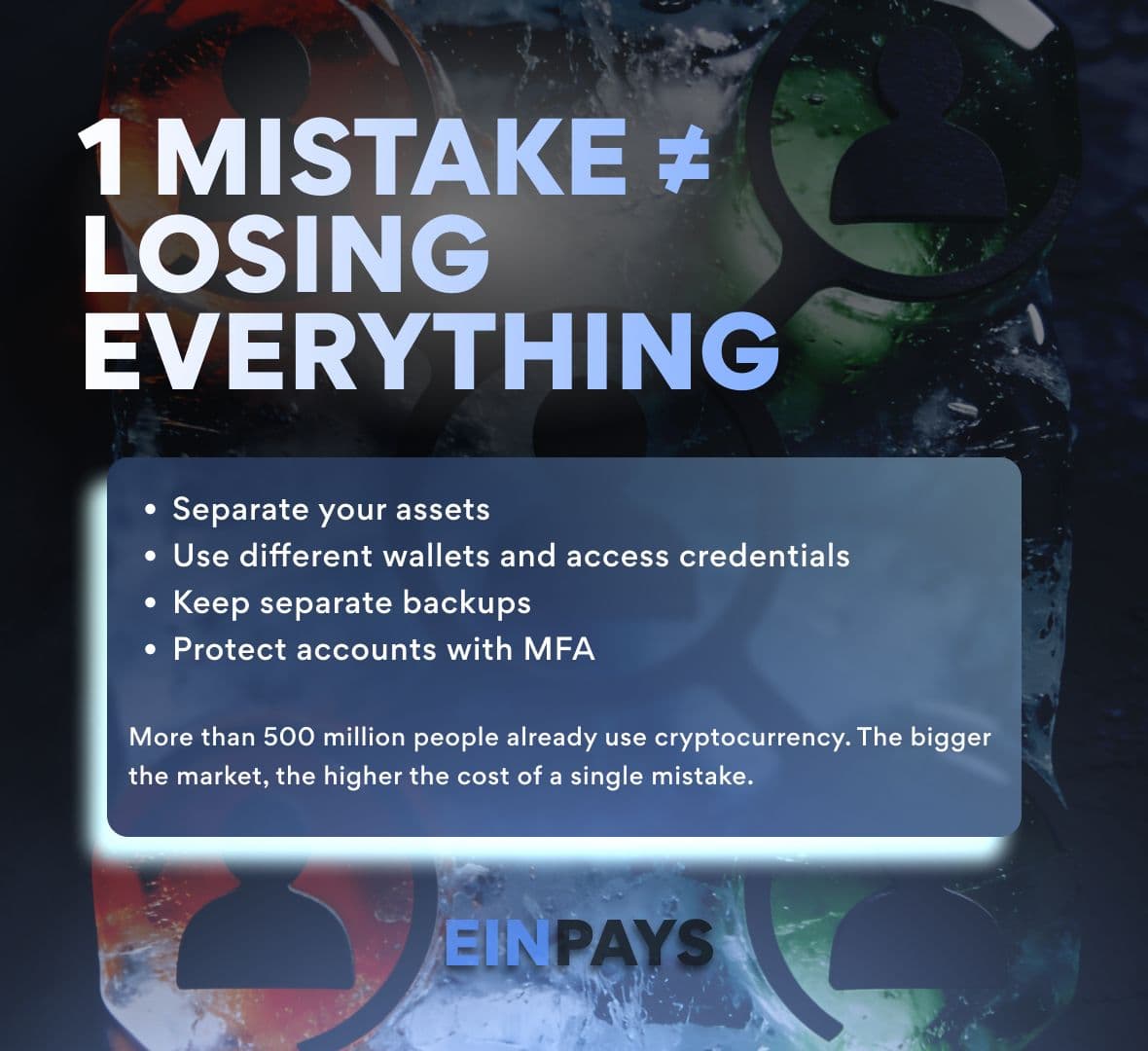
Many users believe that having multiple apps automatically makes storage safer. However, if all wallets use the same seed phrase or are connected to the same email account, the level of protection remains almost unchanged.
The main risks include:
- account hacking or data leaks;
- wallet provider failures or asset custodian restrictions;
- loss of a device or backup;
- user mistakes when transferring funds;
- using unsafe applications or websites. In such cases, the problem affects not just part of the funds, but the entire crypto portfolio.
Common scenarios of losing access
- Account compromise Phishing attacks, weak passwords, or hacked email accounts can give attackers access to all assets if they are stored in one place.
- Platform issues When assets are stored on an exchange, users depend on the service’s operation. Withdrawal restrictions, technical failures, or additional verification procedures can temporarily block access to funds.
- Loss of self-custody access With a personal wallet, responsibility belongs entirely to the owner. If a seed phrase is lost or exposed, access cannot be restored through customer support.
- User mistakes A wrong address, incorrect network selection, or approving a suspicious transaction can result in irreversible loss of funds.
Why multiple wallets do not always solve the problem
Creating several wallets does not completely eliminate risks. If they all operate on the same device, use identical recovery information, or are stored in one location, a single issue can affect the entire portfolio. The goal is not the number of wallets — it is risk separation. The key question is: what single event could potentially block access to all your assets at once?
How to organize crypto storage properly
To reduce risks, assets should be separated based on their purpose. Operational funds — assets used for daily transactions, exchanges, or transfers. Long-term reserves — funds that are not needed regularly and should be stored separately. Experimental assets — tokens and applications that should not be connected to the main portfolio. It is also important to:
- use different access credentials;
- store backups securely;
- enable multi-factor authentication;
- verify addresses and networks before making transfers. This approach helps limit the impact of a single mistake.
For companies working with crypto payments, secure asset storage and transaction processing are especially important. Reliable payment infrastructure should provide not only fast operations but also stability, transparency, and control.
Solutions like Einpays help businesses accept fast and secure payments, simplifying integration and transaction management. This allows companies to focus on product growth instead of dealing with complex payment processes.
Other News
What is a NACH Mandate and what are its key benefits?
07.10.2026
What is a NACH Mandate and what are its key benefits?
Recurring payments — subscriptions, insurance premiums, loan repayments, utility bills, and other regular expenses — require funds to be collected on time. For customers, this means remembering payment dates; for businesses, it means processing a large number of transactions on a regular basis. In India, NACH (National Automated Clearing House) is used to automate such payments. It is a system developed by the NPCI (National Payments Corporation of India) that enables bulk electronic debit and credit transactions between bank accounts. One of the key tools within this system is the NACH Mandate — an electronic authorization that allows a customer to make recurring payments directly from their bank account.
EINPAYS at Forex Expo Dubai 2026!
30.09.2026
EINPAYS at Forex Expo Dubai 2026!
Forex Expo Dubai 2026 has come to an end — and we’re sharing the key highlights from EINPAYS’ participation in one of the notable international events for the forex, fintech, payments, and financial industries. Over two busy days at the Dubai World Trade Centre, the EINPAYS team met with brokers, fintech companies, payment providers, IBs, affiliates, and other representatives of the international market. •Discussed current trends in payments and financial infrastructure •Met potential partners and explored opportunities for collaboration •Exchanged insights on international payments and business payouts •Discussed how to make payment processes faster, simpler, and more efficient •Presented EINPAYS solutions for fast and secure payment processing

Crypto acquiring: a solution or a new headache?
23.09.2026
Crypto acquiring: a solution or a new headache?
Cryptocurrency is used for more than just investing. Today, digital assets are also used for transfers, international settlements, and payments for goods and services. For businesses, this creates new opportunities while also introducing additional risks. That is why crypto acquiring should not be viewed as a universal solution, but rather as a tool that needs to fit a specific business model.


Connect global

Sales
Business Development Manager
Partnership
Account Manager
Business Development Manager
Connect global
Sales
Partnership
Account Manager
Business Development Manager
Business Development Manager


Become a Partner
Do you want to become a partner
Your name
Fill the form to submit
Your Company name
Fill the form to submit
Your E-mail
Fill the form to submit
Countries
Fill the form to submit
Your phone number (Telegram)
Fill the form to submit
Web-site
Fill the form to submit
Contact person
Fill the form to submit
Business
Message