Important Notice: Beware of Scams Using the Name "EINPAYS/EINPAYZ"
We have recently discovered that fraudsters are misusing the name EINPAYS/EINPAYZ to deceive traders, service providers, and other individuals by collecting payments through unauthorized channels.
- If you receive any communication claiming to be from EINPAYS/EINPAYZ and asking for payments or sensitive details, we strongly urge you to verify its authenticity first.
- All the official contact details can be found on https://einpays.com or https://einpayz.com
Verify Before You Act:
To confirm whether a communication is genuinely from EINPAYS/EINPAYZ, please email us at [email protected] before making any payments or sharing any personal information.



Become a Partner
Do you want to become a partner
Your name
Fill the form to submit
Your Company name
Fill the form to submit
Your E-mail
Fill the form to submit
Countries
Fill the form to submit
Your phone number (Telegram)
Fill the form to submit
Web-site
Fill the form to submit
Contact person
Fill the form to submit
Business

Message
Fill the form to submit
Become a Partner
Do you want to become a partner
Your name
Fill the form to submit
Your Company name
Fill the form to submit
Your E-mail
Fill the form to submit
Countries
Fill the form to submit
Your phone number (Telegram)
Fill the form to submit
Web-site
Fill the form to submit
Contact person
Fill the form to submit
Business
Message
Fill the form to submit
What is settlement: payment cycles and settlement timelines

- 2026-09-16
A customer has paid for an order and received a “Payment successful” message, but the merchant still doesn’t see the funds in their bank account. This doesn’t necessarily mean there is an error. A successful payment and the actual receipt of funds are two different stages. Between them come processing, verification, clearing, and settlement — the process of settling the payment. Understanding this process helps businesses manage cash flow, reconcile orders, and know when funds actually become available.
How does a payment flow work?
A typical payment goes through several stages: Authorization — the bank verifies the transaction, available funds, limits, and risks. Capture — the authorized payment is processed. Clearing — participants in the payment system exchange data and determine the amounts owed. Settlement — the calculated amount is transferred to the merchant’s bank account.
In other words: Authorization → capture → clearing → settlement → funds credited. The exact flow depends on the payment method and payment infrastructure.
T+0, T+1, and T+2: what do they mean?
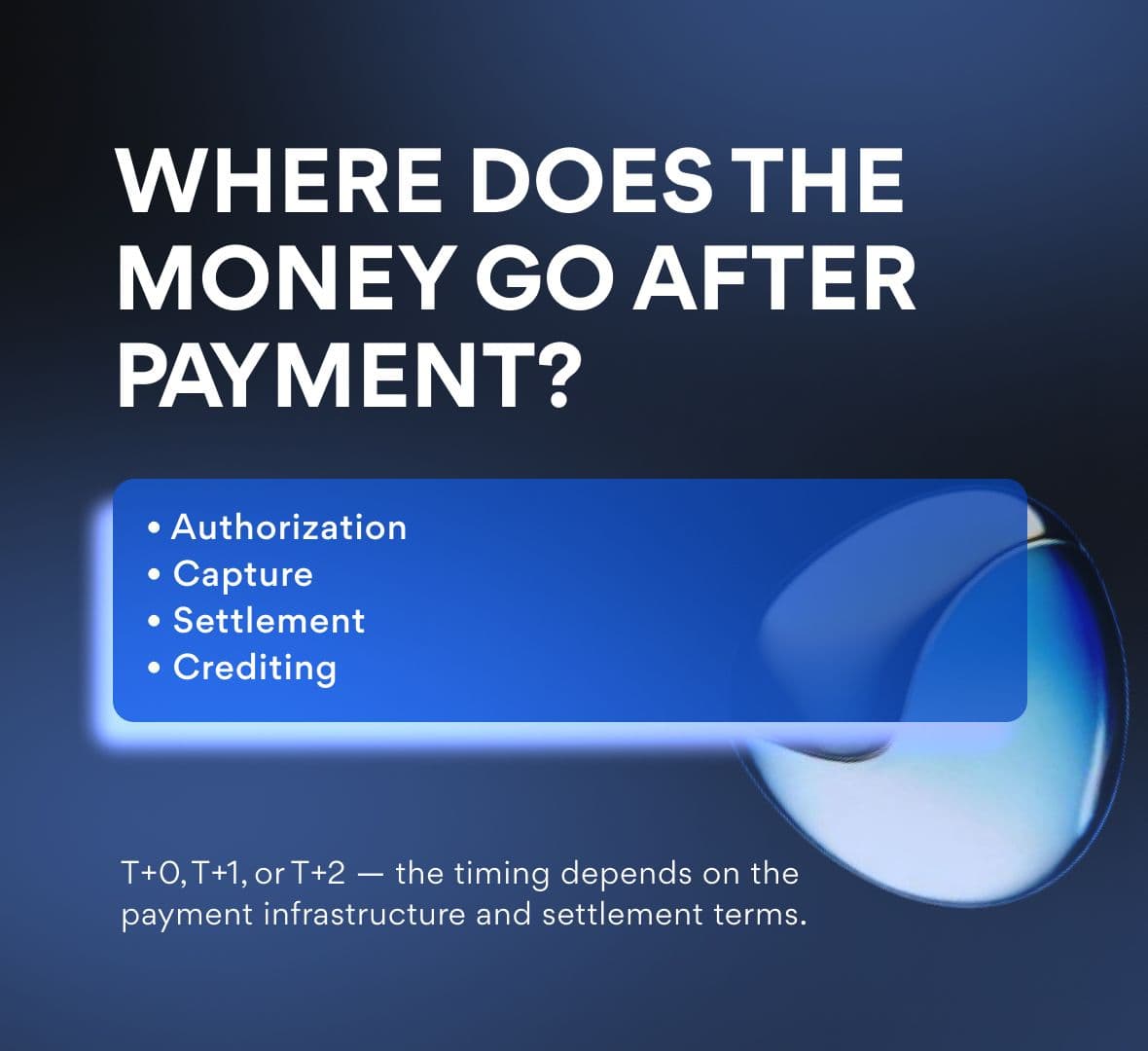
Settlement timelines are often described as T+0, T+1, and T+2:
- T+0 — settlement takes place on the same day as event T;
- T+1 — settlement takes place one eligible day later;
- T+2 — settlement takes place two eligible days later. It’s important to understand what exactly counts as T. It may be a successful transaction or another event specified in the provider’s terms. Business days, bank holidays, and cut-off times may also apply. So T+1 does not necessarily mean “24 hours later.”
Why can settlement be delayed?
Even a successful payment is not always credited immediately. The timeline can be affected by:
- an incomplete KYC/KYB check;
- bank verification;
- additional risk checks;
- weekends and holidays;
- refunds or chargebacks;
- technical or banking issues. That’s why, when a payment is delayed, it’s important to check not only the payment status, but also the settlement date, transaction ID, and UTR.
How is the settlement amount calculated?
The settlement amount may differ from the total sales amount. A simplified formula is: Net amount = successful payments − fees and taxes − refunds − adjustments. For effective control, businesses need a settlement report containing information about transactions, fees, refunds, settlement dates, and bank identifiers.
Payment reconciliation: why is it important?
Payment reconciliation is the process of matching data from orders, payments, settlements, and bank statements. It helps businesses quickly identify:
- a successful payment that hasn’t been credited;
- an amount discrepancy;
- an incorrect fee;
- an unresolved refund;
- a delayed settlement. When transaction volumes are high, this process can be automated.
Which metrics should businesses track?
To monitor the payment process, businesses can track: Payment Success Rate — the share of successful payments; Transaction Failure Rate — the percentage of failed transactions; Settlement Time — the time until funds are credited; Refund Rate — the share of refunded transactions; **Chargeback Rate **— the share of disputed transactions.
These metrics help identify where problems occur — during payment, processing, or settlement.
Why does settlement matter for businesses?
For a customer, the key thing is that the purchase is successfully paid for. For a business, it is also important to know when the funds become available. This affects cash flow, supplier payments, purchasing, and further business growth. That’s why, when choosing a payment solution, it’s important to clarify the settlement cycle, the meaning of T, business days, cut-off times, fees, and refund processing rules in advance. In India, payment aggregator activities are regulated by the Reserve Bank of India (RBI). Non-bank Payment Aggregators are subject to requirements concerning the handling of merchant funds, including the use of an escrow account. Modern payment infrastructure should provide more than fast payment processing. It should also ensure security, stability, transparent settlement, and convenient integration.
Einpays helps businesses organize fast and secure payments, simplify online payment integration, and make transaction processing more convenient and transparent.
Settlement is the final stage of the payment process, when funds are transferred to the merchant after processing and the necessary checks. Understanding T+0, T+1, and T+2, the reasons for possible delays, and the principles of payment reconciliation helps businesses better control their cash flow.
A successful payment is only the beginning. What matters is understanding the entire journey of the money to the business’s bank account.
Other News
What is a NACH Mandate and what are its key benefits?
07.10.2026
What is a NACH Mandate and what are its key benefits?
Recurring payments — subscriptions, insurance premiums, loan repayments, utility bills, and other regular expenses — require funds to be collected on time. For customers, this means remembering payment dates; for businesses, it means processing a large number of transactions on a regular basis. In India, NACH (National Automated Clearing House) is used to automate such payments. It is a system developed by the NPCI (National Payments Corporation of India) that enables bulk electronic debit and credit transactions between bank accounts. One of the key tools within this system is the NACH Mandate — an electronic authorization that allows a customer to make recurring payments directly from their bank account.
EINPAYS at Forex Expo Dubai 2026!
30.09.2026
EINPAYS at Forex Expo Dubai 2026!
Forex Expo Dubai 2026 has come to an end — and we’re sharing the key highlights from EINPAYS’ participation in one of the notable international events for the forex, fintech, payments, and financial industries. Over two busy days at the Dubai World Trade Centre, the EINPAYS team met with brokers, fintech companies, payment providers, IBs, affiliates, and other representatives of the international market. •Discussed current trends in payments and financial infrastructure •Met potential partners and explored opportunities for collaboration •Exchanged insights on international payments and business payouts •Discussed how to make payment processes faster, simpler, and more efficient •Presented EINPAYS solutions for fast and secure payment processing

Crypto acquiring: a solution or a new headache?
23.09.2026
Crypto acquiring: a solution or a new headache?
Cryptocurrency is used for more than just investing. Today, digital assets are also used for transfers, international settlements, and payments for goods and services. For businesses, this creates new opportunities while also introducing additional risks. That is why crypto acquiring should not be viewed as a universal solution, but rather as a tool that needs to fit a specific business model.


Connect global

Sales
Business Development Manager
Partnership
Account Manager
Business Development Manager
Connect global
Sales
Partnership
Account Manager
Business Development Manager
Business Development Manager


Become a Partner
Do you want to become a partner
Your name
Fill the form to submit
Your Company name
Fill the form to submit
Your E-mail
Fill the form to submit
Countries
Fill the form to submit
Your phone number (Telegram)
Fill the form to submit
Web-site
Fill the form to submit
Contact person
Fill the form to submit
Business
Message