Important Notice: Beware of Scams Using the Name "EINPAYS/EINPAYZ"
We have recently discovered that fraudsters are misusing the name EINPAYS/EINPAYZ to deceive traders, service providers, and other individuals by collecting payments through unauthorized channels.
- If you receive any communication claiming to be from EINPAYS/EINPAYZ and asking for payments or sensitive details, we strongly urge you to verify its authenticity first.
- All the official contact details can be found on https://einpays.com or https://einpayz.com
Verify Before You Act:
To confirm whether a communication is genuinely from EINPAYS/EINPAYZ, please email us at [email protected] before making any payments or sharing any personal information.


Become a Partner
Do you want to become a partner
Your name
Fill the form to submit
Your Company name
Fill the form to submit
Your E-mail
Fill the form to submit
Countries
Fill the form to submit
Your phone number (Telegram)
Fill the form to submit
Web-site
Fill the form to submit
Contact person
Fill the form to submit
Business

Message
Fill the form to submit
Become a Partner
Do you want to become a partner
Your name
Fill the form to submit
Your Company name
Fill the form to submit
Your E-mail
Fill the form to submit
Countries
Fill the form to submit
Your phone number (Telegram)
Fill the form to submit
Web-site
Fill the form to submit
Contact person
Fill the form to submit
Business
Message
Fill the form to submit
Online payment security: how to protect a payment gateway
- 2026-10-14
Online payments have become an essential part of doing business, but their growing popularity also brings an increased risk of cyberattacks. Vulnerabilities in a payment gateway can lead to data breaches, fraud, and transaction processing disruptions. Payment gateway security testing helps identify weaknesses and assess the effectiveness of security measures before serious incidents occur.
What is payment gateway security testing?
A payment gateway enables the transmission and processing of data for online payments. Security testing focuses on identifying vulnerabilities in applications, APIs, servers, and access control mechanisms.
Key testing methods include:
- Vulnerability assessment — identifying known vulnerabilities.
- Penetration testing (pentest) — simulating cyberattacks to evaluate system security.
- API security testing — assessing the security of interactions between services.
- Encryption testing — evaluating data protection during transmission and storage.
- Fraud detection testing — verifying the effectiveness of fraud detection mechanisms.
PCI DSS and RBI requirements
PCI DSS (Payment Card Industry Data Security Standard) is a standard for protecting payment card data. It establishes requirements for access control, information security, and regular system testing.
Under applicable PCI DSS requirements, vulnerability scans must be conducted at least once every three months. Penetration testing must be performed at the required intervals and after significant infrastructure changes where the standard specifies it.
In India, payment aggregators and other regulated market participants must also consider the RBI (Reserve Bank of India) requirements for information security and system audits.
OWASP guidelines are widely used to test web applications and APIs, while MFA (Multi-Factor Authentication) helps protect access to critical systems.
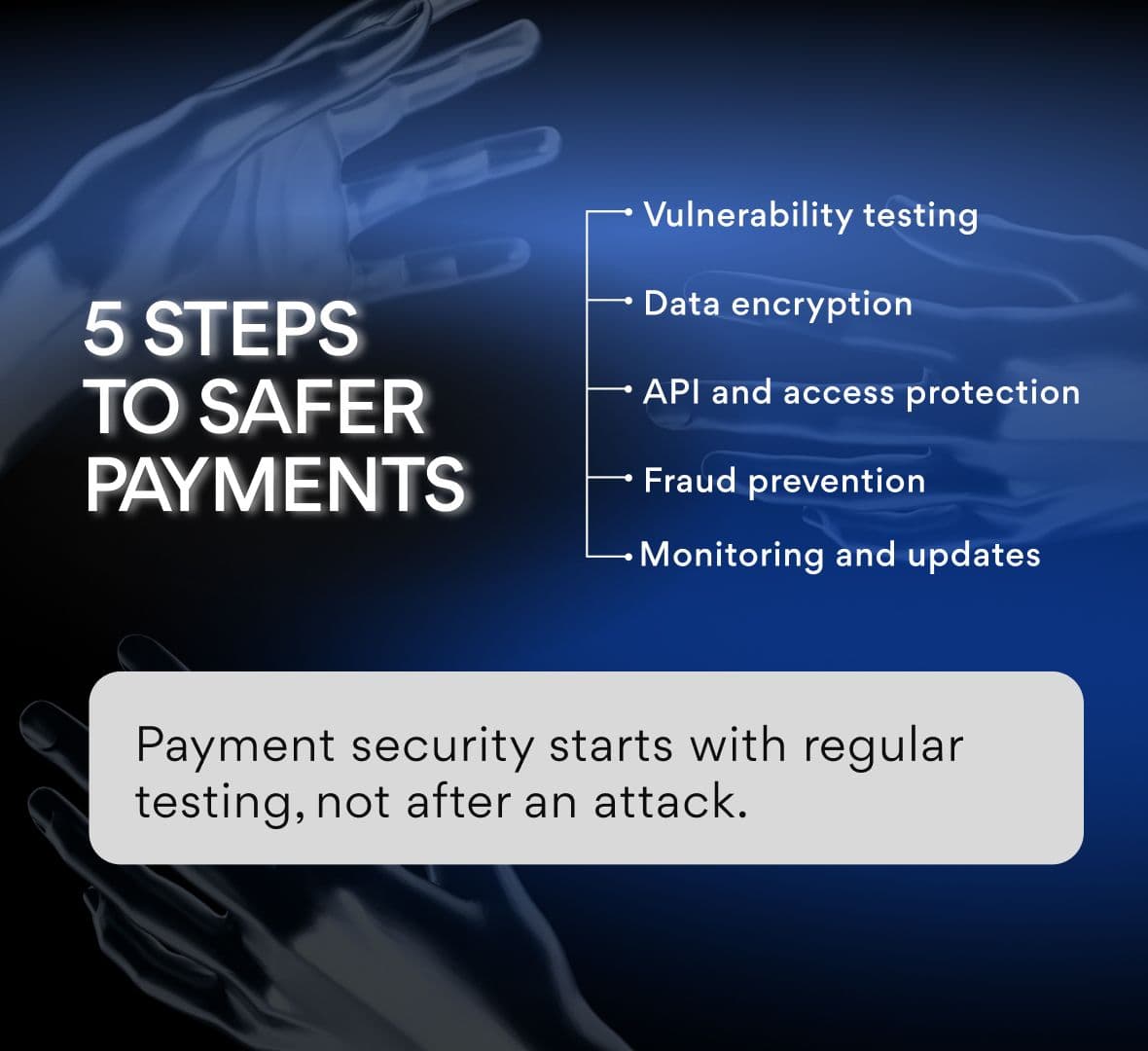
Payment gateway security checklist
- Compliance with standards. Review applicable PCI DSS requirements, audit results, and the remediation of identified vulnerabilities.
- Data encryption. Use secure protocols to transmit information, control access to cryptographic keys, and prevent sensitive data from appearing in unprotected logs.
- Authentication and access control. Enable MFA and assign user permissions based on the principle of least privilege, giving each user only the access they need.
- Vulnerability scanning. Check servers, applications, and software components. Address issues according to their severity.
- Penetration testing. Simulate attack scenarios to determine whether vulnerabilities could be exploited to access data or payment systems.
- API security. Verify request authorization, API key protection, and access controls. The server should independently validate payment amounts and order details rather than relying on data supplied by the client.
- Fraud prevention. Monitor suspicious transactions and test how the system handles duplicate requests, cancellations, and refunds. Idempotency keys can help prevent the same payment from being processed more than once.
- Monitoring and recovery. Track suspicious activity, configure security incident alerts, and regularly test system recovery from backups.
- Security updates. Install software patches promptly and retest components after significant changes.
How often should security checks be performed?
The schedule depends on PCI DSS requirements, system architecture, and the level of risk. It may include:
- Vulnerability scanning at least once every three months, where required by applicable standards.
- Penetration testing at least once a year and after significant changes, where specified by the standard.
- Continuous monitoring of security events.
- Regular reviews of access permissions and system recovery testing.
- Timely installation of security updates.
Additional checks are particularly important after infrastructure changes, the integration of new APIs, or the discovery of critical vulnerabilities.
What should you do after discovering a vulnerability?
Once a vulnerability has been identified, the next steps are to:
- Assess the risk and determine which data or systems may be affected.
- Address the root cause by updating software, changing configurations, or fixing the code.
- Retest the system to confirm that the fix is effective.
- Document the results for internal controls and audits.
This process helps businesses not only identify problems but also systematically reduce risks.
Reliable payment infrastructure must combine fast transaction processing, data protection, and operational transparency.
At EINPAYS, we help businesses facilitate fast and secure payments, simplify online payment integration, and build efficient payment processes.
Security is the foundation of trust in payment infrastructure. A systematic approach helps businesses protect transactions and provide customers with a more reliable payment experience.
Other News
Online payment security: how to protect a payment gateway
14.10.2026
Online payment security: how to protect a payment gateway
Online payments have become an essential part of doing business, but their growing popularity also brings an increased risk of cyberattacks. Vulnerabilities in a payment gateway can lead to data breaches, fraud, and transaction processing disruptions. Payment gateway security testing helps identify weaknesses and assess the effectiveness of security measures before serious incidents occur.
What is a NACH Mandate and what are its key benefits?
07.10.2026
What is a NACH Mandate and what are its key benefits?
Recurring payments — subscriptions, insurance premiums, loan repayments, utility bills, and other regular expenses — require funds to be collected on time. For customers, this means remembering payment dates; for businesses, it means processing a large number of transactions on a regular basis. In India, NACH (National Automated Clearing House) is used to automate such payments. It is a system developed by the NPCI (National Payments Corporation of India) that enables bulk electronic debit and credit transactions between bank accounts. One of the key tools within this system is the NACH Mandate — an electronic authorization that allows a customer to make recurring payments directly from their bank account.
EINPAYS at Forex Expo Dubai 2026!
30.09.2026
EINPAYS at Forex Expo Dubai 2026!
Forex Expo Dubai 2026 has come to an end — and we’re sharing the key highlights from EINPAYS’ participation in one of the notable international events for the forex, fintech, payments, and financial industries. Over two busy days at the Dubai World Trade Centre, the EINPAYS team met with brokers, fintech companies, payment providers, IBs, affiliates, and other representatives of the international market. •Discussed current trends in payments and financial infrastructure •Met potential partners and explored opportunities for collaboration •Exchanged insights on international payments and business payouts •Discussed how to make payment processes faster, simpler, and more efficient •Presented EINPAYS solutions for fast and secure payment processing



Connect global

Sales
Business Development Manager
Partnership
Account Manager
Business Development Manager
Connect global
Sales
Partnership
Account Manager
Business Development Manager
Business Development Manager


Become a Partner
Do you want to become a partner
Your name
Fill the form to submit
Your Company name
Fill the form to submit
Your E-mail
Fill the form to submit
Countries
Fill the form to submit
Your phone number (Telegram)
Fill the form to submit
Web-site
Fill the form to submit
Contact person
Fill the form to submit
Business
Message