Important Notice: Beware of Scams Using the Name "EINPAYS/EINPAYZ"
We have recently discovered that fraudsters are misusing the name EINPAYS/EINPAYZ to deceive traders, service providers, and other individuals by collecting payments through unauthorized channels.
- If you receive any communication claiming to be from EINPAYS/EINPAYZ and asking for payments or sensitive details, we strongly urge you to verify its authenticity first.
- All the official contact details can be found on https://einpays.com or https://einpayz.com
Verify Before You Act:
To confirm whether a communication is genuinely from EINPAYS/EINPAYZ, please email us at [email protected] before making any payments or sharing any personal information.



Become a Partner
Do you want to become a partner
Your name
Fill the form to submit
Your Company name
Fill the form to submit
Your E-mail
Fill the form to submit
Countries
Fill the form to submit
Your phone number (Telegram)
Fill the form to submit
Web-site
Fill the form to submit
Contact person
Fill the form to submit
Business

Message
Fill the form to submit
Become a Partner
Do you want to become a partner
Your name
Fill the form to submit
Your Company name
Fill the form to submit
Your E-mail
Fill the form to submit
Countries
Fill the form to submit
Your phone number (Telegram)
Fill the form to submit
Web-site
Fill the form to submit
Contact person
Fill the form to submit
Business
Message
Fill the form to submit
Pos terminals: how card limits work
- 2026-02-25
In the modern world, cards have become an integral part of everyday financial transactions. Purchases, bill payments, cash withdrawals — we do most of these using a debit or credit card. But behind every convenient transaction, there are rules and restrictions designed to protect your money. One such restriction is POS terminal limits. A POS terminal is a device in stores and other retail outlets that accepts card payments. It processes the card's data, verifies the PIN, and communicates with your bank to complete the transaction. But did you know that behind every such transaction, there's a maximum amount you can spend or withdraw? This is precisely what POS terminal limits manage.
What is a pos limit and why is it needed?
A POS limit is the upper spending boundary for a card when paying at a retail outlet, either for a single transaction or over a specific period (e.g., per day or month). It is set by the bank or financial institution and regulated by local norms to reduce the risk of fraud and unauthorized transactions. The main goal of these limits is security: if the card falls into the wrong hands, potential losses are contained. Additionally, limits help cardholders plan their expenses and stay within permissible amounts for everyday purchases.
Types of limits on pos terminals
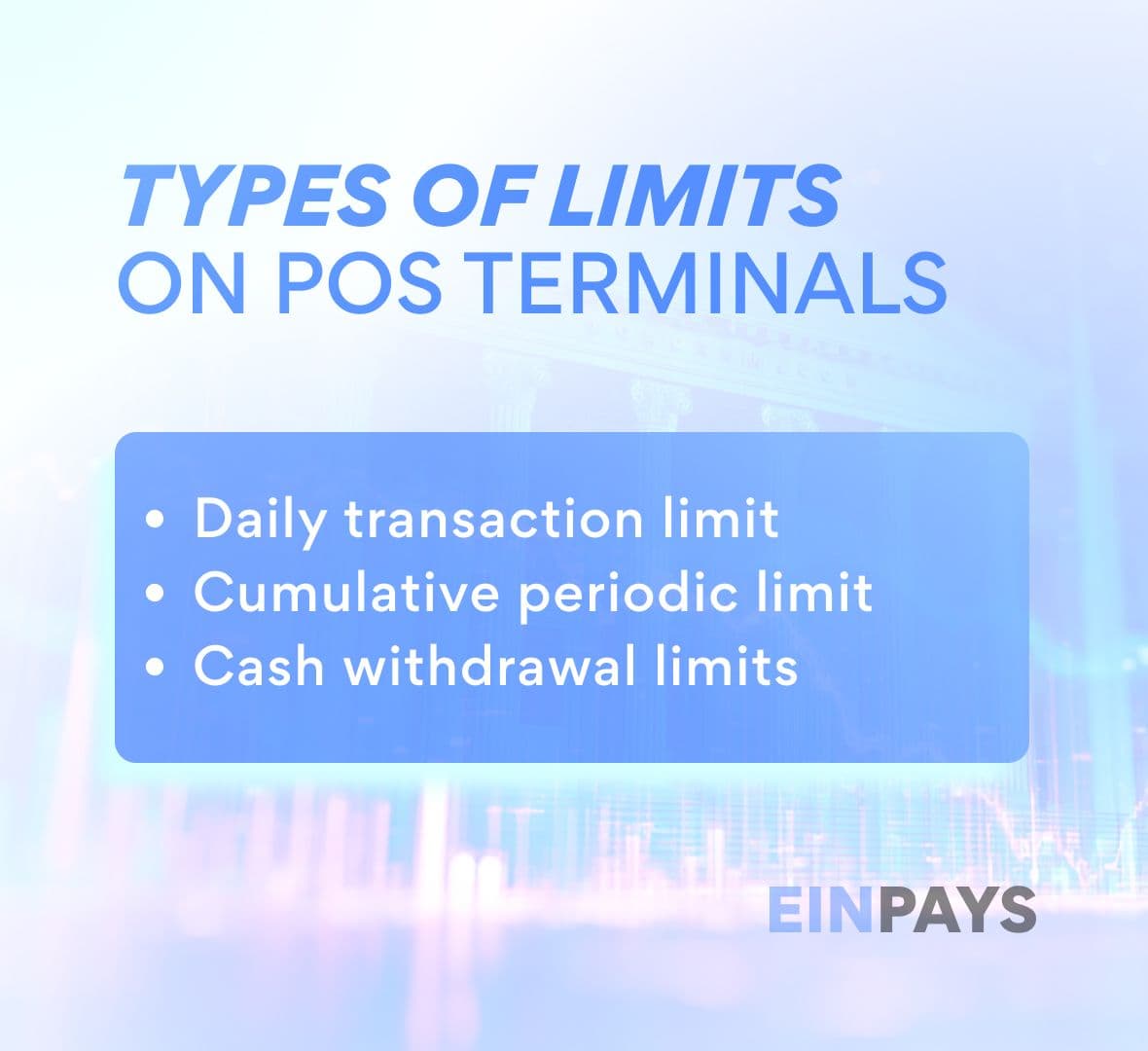
POS terminal limits come in various forms, and it's important to understand how they differ:
-
Daily transaction limit This limit determines the maximum amount that can be spent using a card in a single day. For example, if you make several purchases, the system adds them up, and the total must not exceed the established limit.
-
Cumulative periodic limit Unlike the daily limit, this limit applies over a specific timeframe — a week, a month, or a quarter. It restricts the total sum of all transactions within that period. This allows you to distribute your spending but stay within a safe overall expenditure level.
-
Cash withdrawal limits Some POS terminals allow you to get cash back when paying for goods or services. These transactions also have their own restrictions to protect your funds and prevent misuse.
How are limits set and who controls them?
POS terminal limits depend on several factors:
-
Card type (debit, credit, or prepaid)
-
Account type and customer category
-
Specific bank policy
-
Region and population density of the transaction location
For example, banks may set different limits for large cities versus small towns to align with local characteristics and regulatory requirements.
For cardholders, it's important to remember: limits can be checked in the bank's mobile app or on the financial institution's website. Some banks offer the ability to customize the limit yourself based on user preferences and financial behavior.
How a pos transaction works considering the limit
The payment process with a card via a POS terminal looks simple:
-
You select a product or service and tell the cashier you want to pay by card.
-
The cashier enters the amount into the terminal.
-
You confirm the transaction with a PIN or via contactless method.
-
If the amount does not exceed the limit, the transaction goes through, and funds are debited from your account.
-
If necessary, the POS terminal may dispense cash along with the purchase.
Knowing the limits helps you avoid unpleasant situations where the card is declined due to exceeding the set threshold, and allows you to plan your spending more effectively.
POS transaction limits are not just a formality. They address several key objectives:
-
Security: Limits the risks associated with card theft or loss.
-
Financial control: Helps manage expenses and plan a budget.
-
Compliance with bank requirements: Banks must adhere to regulator rules to protect clients.
-
Flexibility and personalization: With some banks, you can adjust the limit to suit your needs.
Thus, understanding limits and knowing how to manage them makes every transaction safer and more predictable.
Tips for safe use of pos terminals
To ensure your POS transactions go smoothly:
-
Check your limits before making large purchases.
-
Only use secure and official terminals.
-
Never share your PIN with third parties.
-
Keep your receipts to monitor your expenses.
These simple measures will help maximize the security of your funds and simplify the payment process.
With Einpays, you get not only instant and secure payments but also a complete understanding of how your financial transactions work. Convenience, control, and reliability — three key aspects that make managing your money easier than ever.
Other News
Fintech trends in the high-risk segment
15.04.2026
Fintech trends in the high-risk segment: how businesses can grow amid constraints and new opportunities
Financial technologies (fintech) have fundamentally transformed the way businesses handle payments, manage cash flow, and interact with customers. These changes are especially evident in the high-risk segment — an area where companies face increased scrutiny from banks, payment systems, and regulators. High-risk businesses traditionally include companies operating in international e-commerce, subscription services, the crypto industry, iGaming, fintech startups, and other sectors with high transaction volumes or elevated chargeback risks. Despite these challenges, this segment has become one of the key drivers of fintech innovation.
CGST: Full form, meaning, and key provisions of the CGST act
08.04.2026
CGST: Full form, meaning, and key provisions of the CGST act
India today is one of the fastest-growing digital markets in the world. Online payments, e-commerce, and cross-border transactions are expanding at an incredible pace. However, behind this growth lies not only technology but also a well-structured tax system. This is where CGST comes in — one of the key elements of the country’s modern financial infrastructure. If you run a business in India, work with Indian partners, or plan to enter this market, it is important to understand how transaction taxes are formed, how they affect the cost of goods and services, and how to properly account for them in payment processes.
How digital payments are transforming small business in India in 2026
01.04.2026
How digital payments are transforming small business in India in 2026
Digital payments have ceased to be merely a convenient tool—they have become a growth engine for millions of small businesses across India. In 2026, businesses face a new reality: instant transfers, secure electronic transactions, and seamless integration with digital platforms are now necessities for any entrepreneur who wants to grow their business and build customer trust. Small businesses, from street vendors to local shops, have begun to realize how technology is changing their financial day-to-day operations. Fast payment processing, transparent accounting, and access to credit—all of this is becoming possible through digital systems that allow businesses to operate without a cash register and accelerate cash flow.


Connect global

Sales
Business Development Manager
Partnership
Account Manager
Business Development Manager
Connect global
Sales
Partnership
Account Manager
Business Development Manager
Business Development Manager


Become a Partner
Do you want to become a partner
Your name
Fill the form to submit
Your Company name
Fill the form to submit
Your E-mail
Fill the form to submit
Countries
Fill the form to submit
Your phone number (Telegram)
Fill the form to submit
Web-site
Fill the form to submit
Contact person
Fill the form to submit
Business
Message