Important Notice: Beware of Scams Using the Name "EINPAYS/EINPAYZ"
We have recently discovered that fraudsters are misusing the name EINPAYS/EINPAYZ to deceive traders, service providers, and other individuals by collecting payments through unauthorized channels.
- If you receive any communication claiming to be from EINPAYS/EINPAYZ and asking for payments or sensitive details, we strongly urge you to verify its authenticity first.
- All the official contact details can be found on https://einpays.com or https://einpayz.com
Verify Before You Act:
To confirm whether a communication is genuinely from EINPAYS/EINPAYZ, please email us at [email protected] before making any payments or sharing any personal information.



Become a Partner
Do you want to become a partner
Your name
Fill the form to submit
Your Company name
Fill the form to submit
Your E-mail
Fill the form to submit
Countries
Fill the form to submit
Your phone number (Telegram)
Fill the form to submit
Web-site
Fill the form to submit
Contact person
Fill the form to submit
Business

Message
Fill the form to submit
Become a Partner
Do you want to become a partner
Your name
Fill the form to submit
Your Company name
Fill the form to submit
Your E-mail
Fill the form to submit
Countries
Fill the form to submit
Your phone number (Telegram)
Fill the form to submit
Web-site
Fill the form to submit
Contact person
Fill the form to submit
Business
Message
Fill the form to submit
Enhanced due diligence: what businesses need to know
- 2026-03-11
In today's financial world, where fraud and complex international schemes are becoming increasingly sophisticated, it is critically important for financial institutions and companies to know who they are doing business with. This is where the Enhanced Due Diligence (EDD) procedure comes in—an in-depth verification of a client's reliability. EDD is an advanced version of basic Customer Due Diligence (CDD) that goes beyond simply confirming identity and address. It helps identify potential risks, hidden connections, and sources of financial flows, ensuring the reliability and security of transactions.
What is edd and why is it needed
EDD is a proactive, rigorous approach to assessing high-risk clients. It is used by financial institutions, fintech companies, and other organizations handling money flows to protect the business from fraud, money laundering, and sanctions violations.
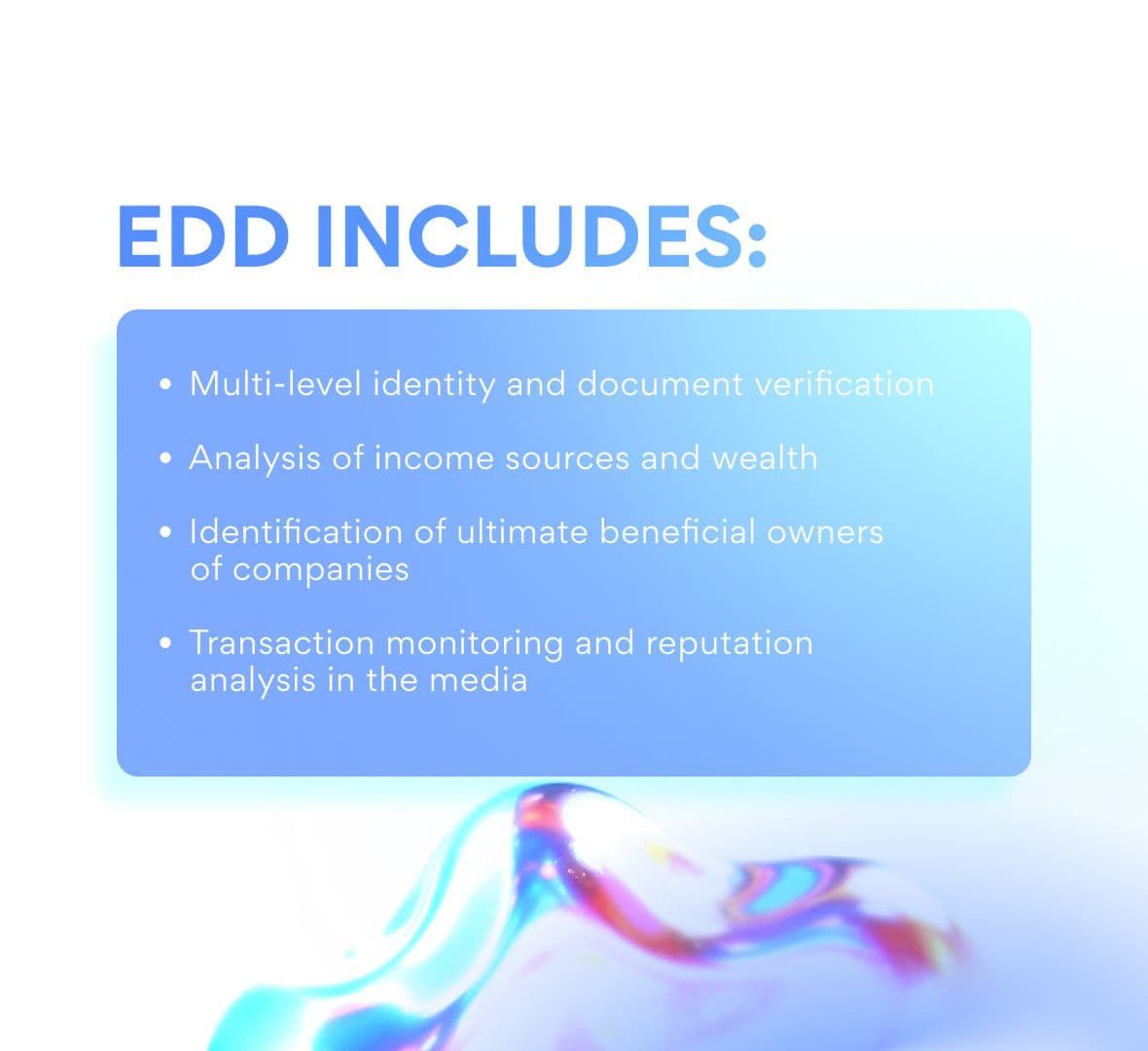
Unlike standard customer verification, EDD includes:
- Multi-level identity and document verification.
- Analysis of income sources and wealth.
- Identification of ultimate beneficial owners of companies.
- Transaction monitoring and reputation analysis in the media.
The goal of EDD is to create an accurate and up-to-date client profile so that the company can make informed decisions and minimize risks.
When is enhanced due diligence applied
Enhanced due diligence is not conducted for all clients. It is triggered when high-risk factors are present:
- Geographical risks — operations in jurisdictions with high levels of financial crime or under sanctions.
- Politically Exposed Persons (PEPs) — individuals with high political authority and their close associates, where there is a potential risk of corruption.
- Complex corporate structures — companies with extensive or opaque ownership structures, including offshore entities.
- Unusual transaction behavior — frequent large transfers, payment structuring, strange money trails.
- Negative media coverage — news about fraud, litigation, or scandals.
- Industry risk — high-risk sectors such as casinos, fintech, precious metals trading.
- Large or irregular account activity — sudden spikes in transactions, especially in new or inactive accounts.
- Client resistance — refusal to provide documents, contradictory information, or evasion of questions about income.
These factors help determine when standard KYC verification is insufficient and additional control measures are needed.
How the edd procedure works
The enhanced due diligence process is always structured and risk-oriented:
- Risk identification — based on geography, industry, client profile, and transaction activity.
- Requests for specific documents — for example, income declarations, financial statements, explanations for complex international transfers.
- Multi-level identity verification — checking documents through official registries, sanctions lists, credit history, and biometric data.
- Verification of wealth and funding sources — examining the origin of funds and their alignment with declared income.
- Identification of ultimate beneficial owners — uncovering individuals who actually control the company, including offshore structures.
- Reputation and media analysis — checking for negative publications, litigation, or sanctions.
- Transaction monitoring — detecting anomalies, structured operations, and unusual money movement patterns.
- Periodic risk reassessment — reviewing the client's profile based on new data, large transactions, or regulatory changes.
- Documentation — recording all verification stages, requests, and decisions for internal audit and regulatory authorities.
This approach allows organizations not just to verify clients, but to build a complete picture of their financial behavior and associated risks.
Difference between edd and standard verification
CDD (Customer Due Diligence) is standard client verification suitable for low and medium risk. It typically includes basic KYC documents and periodic monitoring.
EDD (Enhanced Due Diligence) is an in-depth verification for high-risk clients. It requires an individualized approach, extensive documentation, continuous monitoring, and contextual analysis.
Enhanced Due Diligence is not just a formality or bureaucratic procedure. It is a strategic tool that enables organizations to:
- reduce the risk of financial crime,
- comply with international AML/KYC regulations,
- make informed decisions in complex situations,
- strengthen trust with clients, investors, and regulators.
In an era of fast digital transactions and global financial flows, EDD transforms regulatory compliance from a cost center into a competitive advantage, ensuring business security and transparency.
Einpays payment solutions are designed with modern requirements for security and transparency of financial operations in mind.
Other News
Enhanced due diligence: what businesses need to know
11.03.2026
Enhanced due diligence: what businesses need to know
In today's financial world, where fraud and complex international schemes are becoming increasingly sophisticated, it is critically important for financial institutions and companies to know who they are doing business with. This is where the Enhanced Due Diligence (EDD) procedure comes in—an in-depth verification of a client's reliability. EDD is an advanced version of basic Customer Due Diligence (CDD) that goes beyond simply confirming identity and address. It helps identify potential risks, hidden connections, and sources of financial flows, ensuring the reliability and security of transactions.
Online company registration in India: a step-by-step guide for entrepreneurs
04.03.2026
Online company registration in India: a step-by-step guide for entrepreneurs
India is one of the fastest-growing markets in the world. Its developed digital infrastructure, massive consumer base, and high investment activity make the country attractive for launching both local and international projects. However, entering the market does not begin with sales. It begins with the right legal structure. Online company registration in India is a strategic step. It determines asset protection, the ability to attract investment, access to banking services, and the level of trust from partners.

Pos terminals: how card limits work
25.02.2026
Pos terminals: how card limits work
In the modern world, cards have become an integral part of everyday financial transactions. Purchases, bill payments, cash withdrawals — we do most of these using a debit or credit card. But behind every convenient transaction, there are rules and restrictions designed to protect your money. One such restriction is POS terminal limits. A POS terminal is a device in stores and other retail outlets that accepts card payments. It processes the card's data, verifies the PIN, and communicates with your bank to complete the transaction. But did you know that behind every such transaction, there's a maximum amount you can spend or withdraw? This is precisely what POS terminal limits manage.


Connect global

Sales
Business Development Manager
Partnership
Account Manager
Business Development Manager
Connect global
Sales
Partnership
Account Manager
Business Development Manager
Business Development Manager


Become a Partner
Do you want to become a partner
Your name
Fill the form to submit
Your Company name
Fill the form to submit
Your E-mail
Fill the form to submit
Countries
Fill the form to submit
Your phone number (Telegram)
Fill the form to submit
Web-site
Fill the form to submit
Contact person
Fill the form to submit
Business
Message