Important Notice: Beware of Scams Using the Name "EINPAYS/EINPAYZ"
We have recently discovered that fraudsters are misusing the name EINPAYS/EINPAYZ to deceive traders, service providers, and other individuals by collecting payments through unauthorized channels.
- If you receive any communication claiming to be from EINPAYS/EINPAYZ and asking for payments or sensitive details, we strongly urge you to verify its authenticity first.
- All the official contact details can be found on https://einpays.com or https://einpayz.com
Verify Before You Act:
To confirm whether a communication is genuinely from EINPAYS/EINPAYZ, please email us at [email protected] before making any payments or sharing any personal information.



Become a Partner
Do you want to become a partner
Your name
Fill the form to submit
Your Company name
Fill the form to submit
Your E-mail
Fill the form to submit
Countries
Fill the form to submit
Your phone number (Telegram)
Fill the form to submit
Web-site
Fill the form to submit
Contact person
Fill the form to submit
Business

Message
Fill the form to submit
Become a Partner
Do you want to become a partner
Your name
Fill the form to submit
Your Company name
Fill the form to submit
Your E-mail
Fill the form to submit
Countries
Fill the form to submit
Your phone number (Telegram)
Fill the form to submit
Web-site
Fill the form to submit
Contact person
Fill the form to submit
Business
Message
Fill the form to submit
CGST: Full form, meaning, and key provisions of the CGST act
- 2026-04-08
India today is one of the fastest-growing digital markets in the world. Online payments, e-commerce, and cross-border transactions are expanding at an incredible pace. However, behind this growth lies not only technology but also a well-structured tax system. This is where CGST comes in — one of the key elements of the country’s modern financial infrastructure. If you run a business in India, work with Indian partners, or plan to enter this market, it is important to understand how transaction taxes are formed, how they affect the cost of goods and services, and how to properly account for them in payment processes.
What CGST is in simple terms
CGST stands for Central Goods and Services Tax, which applies to transactions conducted within a single state in India. Simply put, if a company sells a product or provides a service within the same state, part of the tax goes to the central government — this portion is known as CGST. It is part of the unified GST system, which replaced multiple fragmented taxes and made the tax structure more transparent and predictable for businesses.
How the CGST system works
To understand the mechanism, it helps to look at the bigger picture.
When a sale occurs within a state:
- the tax is divided into two parts;
- one part goes to the state government;
- the other goes to the central government (this is CGST). For example, if the applicable tax rate is 18%, it is effectively split into two equal parts.
This creates a more balanced system that takes into account the interests of both the central and regional governments. For businesses, it means one thing: taxation becomes more transparent and easier to forecast when calculating the cost of goods or services.
How CGST is calculated
First, the value of the goods or services is determined — the amount paid by the customer.
Then a tax rate is applied depending on the category:
- essential goods may have a minimal rate;
- mass-market products and services usually fall under a medium rate;
- premium segments may have higher tax rates. The calculation itself is simply a proportion of the value.
For example: If a product costs 10,000 rupees and the applicable rate is 18%, the tax is split into two parts: half as CGST; half as the state-level tax.
As a result, the customer pays the final amount including tax, while the business must correctly allocate and report these payments.
Key provisions of the CGST Act
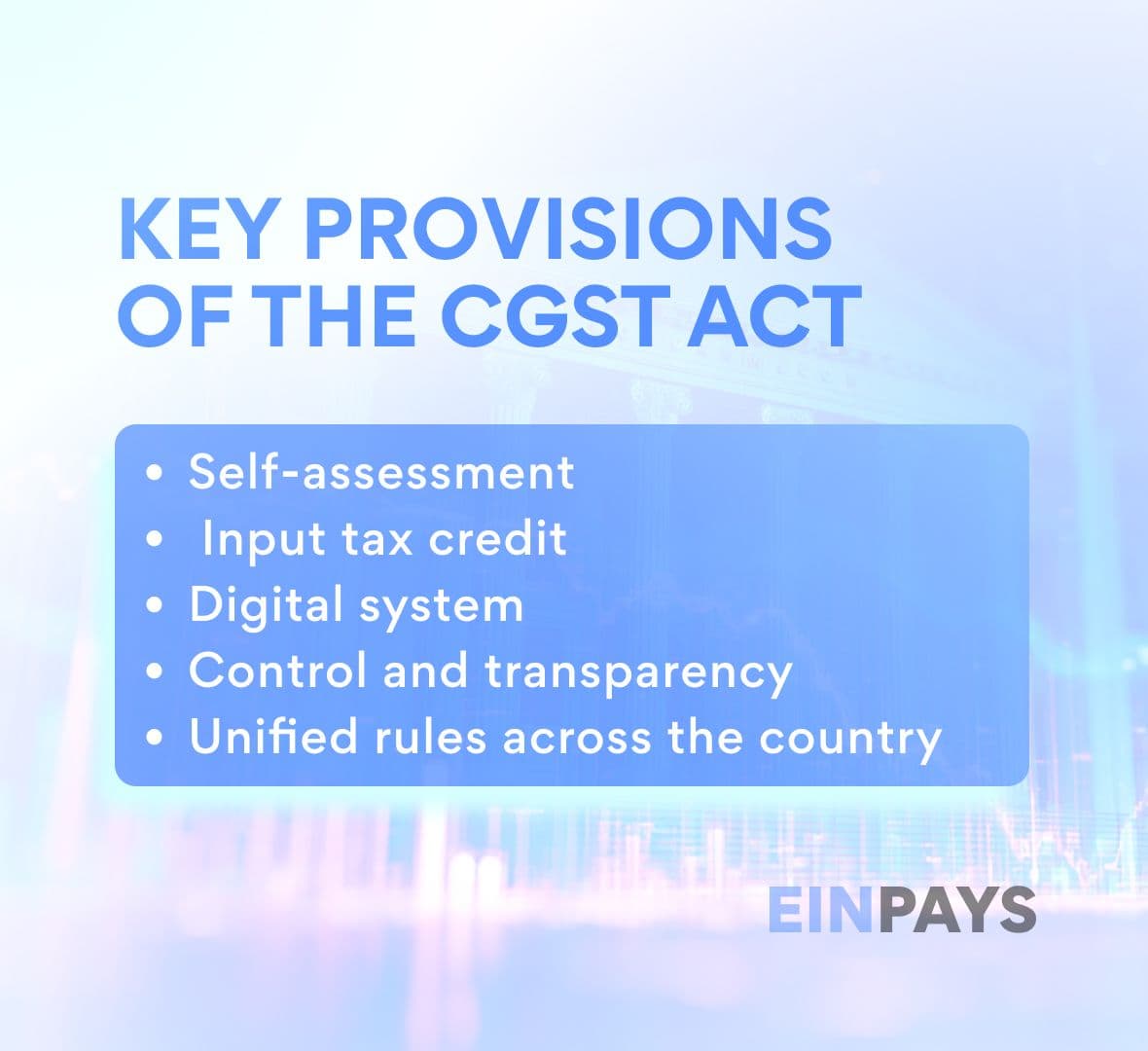
The law regulating CGST became the foundation of India’s modern tax system. Here are its key principles that businesses should understand.
- Self-assessment Companies calculate their own taxes and submit reports themselves. This increases transparency and reduces bureaucracy.
- Input tax credit If a business has already paid tax when purchasing goods or services, it can claim that amount as a credit when selling. This reduces the real tax burden and helps maintain healthy cash flow.
- Digital system Almost all processes — registration, reporting, and payments — are conducted online. India has made a strong shift toward digital infrastructure, which significantly simplifies compliance for companies.
- Control and transparency The system is designed to minimize errors and reduce opportunities for tax evasion.
- Unified rules across the country Despite differences between states, the basic logic of taxation remains the same nationwide.
Why CGST matters for businesses
At first glance, CGST may seem like just another tax. In reality, it is a tool that directly affects a company’s financial operations.
Here is what it changes:
Simplified business operations Companies no longer need to navigate dozens of different taxes — the structure is clearer and easier to manage.
Transparent pricing Businesses can calculate prices more easily and explain them to customers.
Better cash flow control Companies gain a clearer understanding of how much they actually earn and how much goes to taxes.
Lower effective tax burden The input tax credit mechanism reduces the “tax-on-tax” effect. ** Scalability** A unified system makes it easier to expand into new regions and operate across the country.
CGST is one of the elements that makes the Indian market more transparent, technology-driven, and business-friendly. It simplifies processes, reduces administrative burdens, and helps companies operate within a clear legal framework.
However, in today’s economy, simply understanding taxes is no longer enough. What matters is how these taxes are integrated into real financial operations. That is why businesses need solutions that combine payment speed, security, and full transparency of financial processes.
Einpays provides this foundation — helping companies confidently manage payments, control cash flow, and scale in fast-growing markets, including India.
Other News
What Is a Cryptocurrency Swap and how to start exchanging without unnecessary complications?
27.05.2026
What Is a Cryptocurrency Swap and how to start exchanging without unnecessary complications?
The cryptocurrency market is evolving rapidly, and with it, the ways of managing digital assets are changing as well. Today, users no longer need to go through complex and costly chains of operations to exchange one coin for another. A faster and more flexible tool has replaced the traditional model — the cryptocurrency swap. A swap allows users to instantly exchange digital assets within the blockchain ecosystem, without involving banks or converting funds into fiat currency. This makes the process not only faster but also significantly more cost-effective. For users, this opens up new opportunities: participating in various projects, optimizing investment portfolios, and reacting quickly to market changes.
Sales through personal branding: how experts and online businesses can accept more payments
20.05.2026
Sales through personal branding: how experts and online businesses can accept more payments
In 2026, personal branding has become one of the most powerful tools for online sales. People no longer buy only a product or service — they buy trust, reputation, and expertise. That is why freelancers, consultants, digital specialists, owners of online schools, iGaming projects, high-risk platforms, and e-commerce businesses are increasingly building sales around their personal identity or company brand. However, even a strong personal brand does not guarantee stable revenue if a business lacks a well-structured sales system and convenient payment infrastructure. A user may become interested in a product but abandon the purchase due to complicated payment flows, slow transaction confirmation, or the absence of familiar payment methods. Today, it is not enough for online businesses to simply attract an audience — they must also turn attention into fast and secure payments.

Do you need to pay GST for online sales in India? Rules, limits, and understanding TCS
13.05.2026
Do you need to pay GST for online sales in India? Rules, limits, and understanding TCS
India’s e-commerce market is growing rapidly. But alongside the rise of online sales comes a key question: do businesses need to pay GST when selling goods and services online? The short answer: it depends on the sales model. If a seller operates through a marketplace, GST registration is usually required from the very beginning. If sales are made through a personal website, standard turnover thresholds may apply: ₹40 lakh for goods and ₹20 lakh for services in most Indian states. These thresholds are confirmed by GST Council guidelines and GST tax reference materials. For online businesses, this is far more than a formality. GST affects marketplace access, tax calculations, TCS deductions, refunds, reporting obligations, and overall cash flow. That is why sellers should understand the rules before making their first sale.


Connect global

Sales
Business Development Manager
Partnership
Account Manager
Business Development Manager
Connect global
Sales
Partnership
Account Manager
Business Development Manager
Business Development Manager


Become a Partner
Do you want to become a partner
Your name
Fill the form to submit
Your Company name
Fill the form to submit
Your E-mail
Fill the form to submit
Countries
Fill the form to submit
Your phone number (Telegram)
Fill the form to submit
Web-site
Fill the form to submit
Contact person
Fill the form to submit
Business
Message