Important Notice: Beware of Scams Using the Name "EINPAYS/EINPAYZ"
We have recently discovered that fraudsters are misusing the name EINPAYS/EINPAYZ to deceive traders, service providers, and other individuals by collecting payments through unauthorized channels.
- If you receive any communication claiming to be from EINPAYS/EINPAYZ and asking for payments or sensitive details, we strongly urge you to verify its authenticity first.
- All the official contact details can be found on https://einpays.com or https://einpayz.com
Verify Before You Act:
To confirm whether a communication is genuinely from EINPAYS/EINPAYZ, please email us at [email protected] before making any payments or sharing any personal information.



Become a Partner
Do you want to become a partner
Your name
Fill the form to submit
Your Company name
Fill the form to submit
Your E-mail
Fill the form to submit
Countries
Fill the form to submit
Your phone number (Telegram)
Fill the form to submit
Web-site
Fill the form to submit
Contact person
Fill the form to submit
Business

Message
Fill the form to submit
Become a Partner
Do you want to become a partner
Your name
Fill the form to submit
Your Company name
Fill the form to submit
Your E-mail
Fill the form to submit
Countries
Fill the form to submit
Your phone number (Telegram)
Fill the form to submit
Web-site
Fill the form to submit
Contact person
Fill the form to submit
Business
Message
Fill the form to submit
Fintech trends in the high-risk segment: how businesses can grow amid constraints and new opportunities
- 2026-04-15
Financial technologies (fintech) have fundamentally transformed the way businesses handle payments, manage cash flow, and interact with customers. These changes are especially evident in the high-risk segment — an area where companies face increased scrutiny from banks, payment systems, and regulators. High-risk businesses traditionally include companies operating in international e-commerce, subscription services, the crypto industry, iGaming, fintech startups, and other sectors with high transaction volumes or elevated chargeback risks. Despite these challenges, this segment has become one of the key drivers of fintech innovation.
Instant payments as the new standard
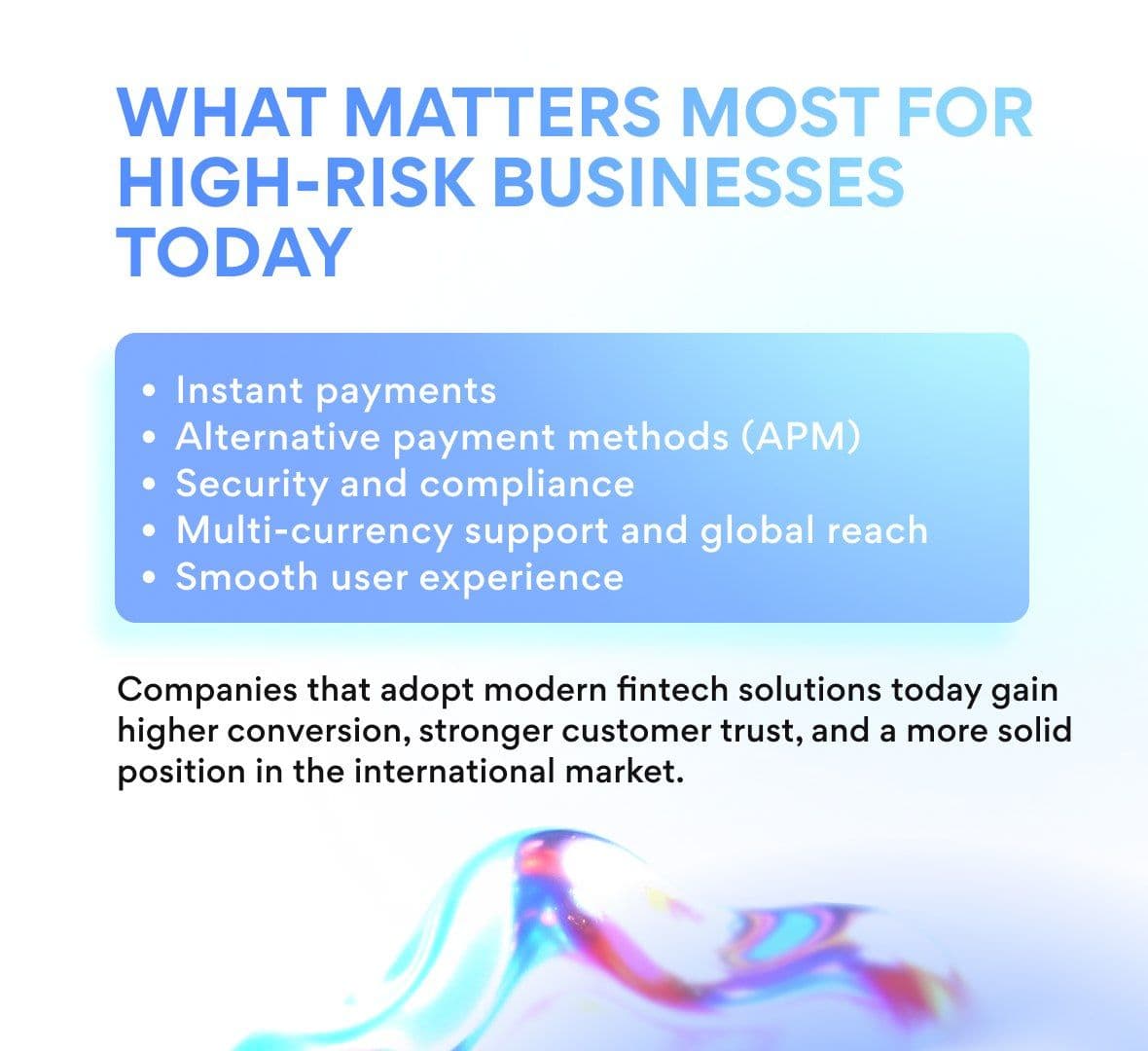
Just a few years ago, waiting several hours for payment processing was considered normal. Today, speed has become a critical factor. According to payment behavior studies:
- each additional second of delay reduces conversion by 3–5%;
- up to 18% of users abandon purchases if payments are not processed instantly;
- in high-risk industries, losses can reach 25–30% due to delays and declines;
- up to 70% of users leave a website if the payment process is too slow or вызывает doubt — and this figure can be even higher in high-risk segments.
Instant payments allow businesses to:
- reduce transaction processing time to seconds;
- increase conversion rates at checkout;
- improve user experience;
- reduce the number of abandoned transactions.
Growth of alternative payment methods (APM)
One of the most noticeable trends in recent years is the shift away from traditional bank cards. Key facts:
- alternative payment methods (e-wallets, local systems, bank transfers) now account for over 55% of global online payments;
- in Europe and Asia, this figure reaches 60–70%;
- younger audiences (18–35) are twice as likely to choose e-wallets over cards.
For high-risk businesses, this is especially important because:
- card payments are more frequently declined;
- banks apply stricter filters to such transactions;
- fees are typically higher. Companies that fail to adapt to APM risk losing a significant share of customers.
Stronger security and compliance requirements
The high-risk segment is under constant scrutiny from regulators and financial institutions due to increased risks of fraud, chargebacks, and financial violations.
Modern fintech security trends include:
- implementation of multi-layered security systems;
- use of AI and machine learning to detect suspicious transactions;
- stricter KYC (Know Your Customer) and AML (Anti-Money Laundering) procedures;
- enhanced transparency and transaction traceability.
Companies that ignore these requirements risk account freezes and restrictions from payment providers.
Simple and fast integration
Speed to market (time-to-market) is now a decisive factor. Long and complex technical integrations can cost businesses both customers and revenue. As a result, simplifying the integration of payment solutions has become a key trend.
Modern business requirements include:
- fast integration with minimal setup time;
- clear and accessible technical documentation;
- no complex configurations;
- transparent onboarding terms.
Einpays offers free and user-friendly integration for websites, enabling companies to quickly connect payment infrastructure and start accepting payments without unnecessary costs.
Globalization and multi-currency support
High-risk businesses rarely operate within a single market. Most companies serve customers across multiple countries, requiring flexible payment infrastructure.
Key trends include:
- support for multiple currencies;
- local payment methods (cards, e-wallets, alternative payments);
- adaptation to regional specifics;
- a unified payment management system.
Global expansion requires not only technical readiness but also a reliable payment partner.
Focus on user experience (UX)
Modern customers expect a simple and seamless payment process. Any friction — extra fields, delays, or errors — directly impacts conversion rates. This is especially critical in high-risk segments, where user trust is already lower.
UX trends include:
- minimalistic checkout processes;
- mobile-first optimization;
- instant transaction confirmations;
- transparency at every stage.
The high-risk segment is no longer a limitation to growth — on the contrary, it has become a space for innovation and development. It is here that new fintech standards are formed and later adopted across the entire market. Companies that implement these solutions early gain a significant competitive advantage. Einpays already provides businesses with tools that enable faster, safer, and more efficient operations—regardless of the complexity of the segment.
Other News
What Is a Cryptocurrency Swap and how to start exchanging without unnecessary complications?
27.05.2026
What Is a Cryptocurrency Swap and how to start exchanging without unnecessary complications?
The cryptocurrency market is evolving rapidly, and with it, the ways of managing digital assets are changing as well. Today, users no longer need to go through complex and costly chains of operations to exchange one coin for another. A faster and more flexible tool has replaced the traditional model — the cryptocurrency swap. A swap allows users to instantly exchange digital assets within the blockchain ecosystem, without involving banks or converting funds into fiat currency. This makes the process not only faster but also significantly more cost-effective. For users, this opens up new opportunities: participating in various projects, optimizing investment portfolios, and reacting quickly to market changes.
Sales through personal branding: how experts and online businesses can accept more payments
20.05.2026
Sales through personal branding: how experts and online businesses can accept more payments
In 2026, personal branding has become one of the most powerful tools for online sales. People no longer buy only a product or service — they buy trust, reputation, and expertise. That is why freelancers, consultants, digital specialists, owners of online schools, iGaming projects, high-risk platforms, and e-commerce businesses are increasingly building sales around their personal identity or company brand. However, even a strong personal brand does not guarantee stable revenue if a business lacks a well-structured sales system and convenient payment infrastructure. A user may become interested in a product but abandon the purchase due to complicated payment flows, slow transaction confirmation, or the absence of familiar payment methods. Today, it is not enough for online businesses to simply attract an audience — they must also turn attention into fast and secure payments.
Do you need to pay GST for online sales in India? Rules, limits, and understanding TCS
13.05.2026
Do you need to pay GST for online sales in India? Rules, limits, and understanding TCS
India’s e-commerce market is growing rapidly. But alongside the rise of online sales comes a key question: do businesses need to pay GST when selling goods and services online? The short answer: it depends on the sales model. If a seller operates through a marketplace, GST registration is usually required from the very beginning. If sales are made through a personal website, standard turnover thresholds may apply: ₹40 lakh for goods and ₹20 lakh for services in most Indian states. These thresholds are confirmed by GST Council guidelines and GST tax reference materials. For online businesses, this is far more than a formality. GST affects marketplace access, tax calculations, TCS deductions, refunds, reporting obligations, and overall cash flow. That is why sellers should understand the rules before making their first sale.


Connect global

Sales
Business Development Manager
Partnership
Account Manager
Business Development Manager
Connect global
Sales
Partnership
Account Manager
Business Development Manager
Business Development Manager


Become a Partner
Do you want to become a partner
Your name
Fill the form to submit
Your Company name
Fill the form to submit
Your E-mail
Fill the form to submit
Countries
Fill the form to submit
Your phone number (Telegram)
Fill the form to submit
Web-site
Fill the form to submit
Contact person
Fill the form to submit
Business
Message