Important Notice: Beware of Scams Using the Name "EINPAYS/EINPAYZ"
We have recently discovered that fraudsters are misusing the name EINPAYS/EINPAYZ to deceive traders, service providers, and other individuals by collecting payments through unauthorized channels.
- If you receive any communication claiming to be from EINPAYS/EINPAYZ and asking for payments or sensitive details, we strongly urge you to verify its authenticity first.
- All the official contact details can be found on https://einpays.com or https://einpayz.com
Verify Before You Act:
To confirm whether a communication is genuinely from EINPAYS/EINPAYZ, please email us at [email protected] before making any payments or sharing any personal information.



Become a Partner
Do you want to become a partner
Your name
Fill the form to submit
Your Company name
Fill the form to submit
Your E-mail
Fill the form to submit
Countries
Fill the form to submit
Your phone number (Telegram)
Fill the form to submit
Web-site
Fill the form to submit
Contact person
Fill the form to submit
Business

Message
Fill the form to submit
Become a Partner
Do you want to become a partner
Your name
Fill the form to submit
Your Company name
Fill the form to submit
Your E-mail
Fill the form to submit
Countries
Fill the form to submit
Your phone number (Telegram)
Fill the form to submit
Web-site
Fill the form to submit
Contact person
Fill the form to submit
Business
Message
Fill the form to submit
MT103 vs MT202: understanding the key differences in international payments in 2026
- 2026-04-22
Why it is important for businesses to understand the difference between MT103 and MT202 International transfers have long become part of everyday business operations. Companies pay suppliers, work with overseas contractors, and receive payments from around the world. Yet even in 2026, one of the most common problems remains the same: the money is “sent,” but it never reaches the recipient’s account. This is especially common in high-risk industries, where international payments pass through multiple intermediary banks, compliance checks, and AML filters. One of the main reasons for confusion is the lack of understanding of the difference between MT103 and MT202. For businesses, this is no longer just a technical detail — it is an important tool for controlling international payments and reducing financial risks.
What is MT103
MT103 is a message type used for international customer transfers. This document confirms that the bank has received instructions to send money to a specific recipient.
An MT103 contains:
- sender details;
- recipient information;
- beneficiary account number;
- transfer amount and currency;
- payment purpose;
- fee information.
This is why MT103 is considered the primary proof of an international payment.
After the banking system transitioned to the ISO 20022 standard in 2025, the technical equivalent of MT103 became the pacs.008 format. However, most banks still commonly refer to it as MT103.
Why MT202 does not confirm payment
MT202 is often mistakenly seen as proof of payment, although its purpose is entirely different.
This format is used exclusively for settlements between banks. It reflects the movement of funds between financial institutions, not the fact that money has been credited to a specific recipient.
Simply put:
- MT103 shows who the money was sent to;
- MT202 is used for interbank settlements.
MT202 usually does not include complete beneficiary details, which means it cannot serve as proof that the funds will arrive in your account.
Following the transition to ISO 20022, the equivalent of MT202 became the pacs.009 format, though its function remains unchanged.
Why payments may be delayed
In 2026, international transfers have become technologically more complex. A single payment may pass through several correspondent banks and additional security checks.
According to international payment analytics, around 11–14% of cross-border transfers are delayed due to compliance and intermediary reviews.
In high-risk industries, this percentage is even higher.
That is why the existence of an MT202 does not mean that the funds are already available to the recipient.
Cover Method: why confusion happens
One of the reasons for delays is the use of the so-called Cover Method.
In this case:
- MT103 is sent as a payment notification;
- MT202 travels separately through correspondent banks;
- the actual funds may take longer to arrive than the payment message itself.
As a result, the recipient may see confirmation of the transfer but still not see the funds credited to the account.
UETR — the key tool for tracking payments
Today, a crucial role in tracking international transfers is played by the UETR (Unique End-to-End Transaction Reference).
This is a unique 36-character code that follows the payment throughout its entire journey.
UETR allows businesses to:
- quickly determine the location of a transfer;
- identify at which stage a delay occurred;
- accelerate payment tracing through banks.
If an international transfer is delayed, businesses should request not only the MT103 but also the UETR.
In 2026, understanding the differences between MT103 and MT202 has become essential for any business working with international transfers.
It is important to remember:
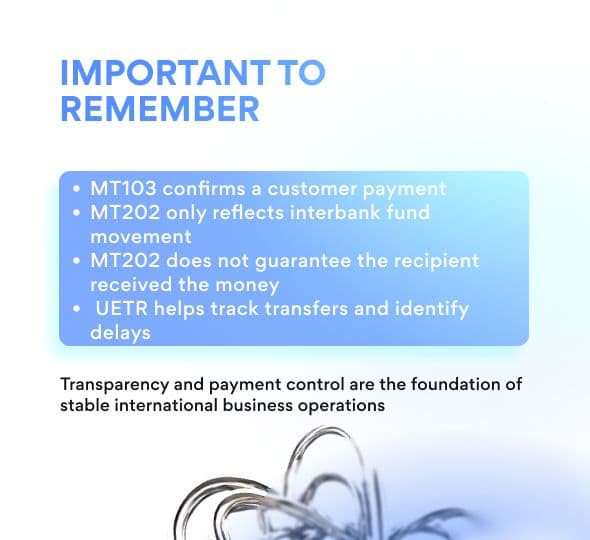
- MT103 confirms a customer payment;
- MT202 reflects only interbank movement of funds;
- the existence of MT202 does not mean the money has reached the account;
- UETR helps quickly track transfers.
Despite the banking industry’s transition to ISO 20022 and the introduction of new formats such as pacs.008 and pacs.009, the core principles of international settlements remain the same.
Companies that understand how international payments work resolve transfer issues faster, reduce financial risks, and manage cash flow more effectively.
As global payments become increasingly complex, transparency, speed, and control are becoming the foundation of stable international business operations.
With solutions from Einpays, businesses gain faster, more transparent, and more reliable international payments — even within complex high-risk infrastructures.
Other News
What Is a Cryptocurrency Swap and how to start exchanging without unnecessary complications?
27.05.2026
What Is a Cryptocurrency Swap and how to start exchanging without unnecessary complications?
The cryptocurrency market is evolving rapidly, and with it, the ways of managing digital assets are changing as well. Today, users no longer need to go through complex and costly chains of operations to exchange one coin for another. A faster and more flexible tool has replaced the traditional model — the cryptocurrency swap. A swap allows users to instantly exchange digital assets within the blockchain ecosystem, without involving banks or converting funds into fiat currency. This makes the process not only faster but also significantly more cost-effective. For users, this opens up new opportunities: participating in various projects, optimizing investment portfolios, and reacting quickly to market changes.
Sales through personal branding: how experts and online businesses can accept more payments
20.05.2026
Sales through personal branding: how experts and online businesses can accept more payments
In 2026, personal branding has become one of the most powerful tools for online sales. People no longer buy only a product or service — they buy trust, reputation, and expertise. That is why freelancers, consultants, digital specialists, owners of online schools, iGaming projects, high-risk platforms, and e-commerce businesses are increasingly building sales around their personal identity or company brand. However, even a strong personal brand does not guarantee stable revenue if a business lacks a well-structured sales system and convenient payment infrastructure. A user may become interested in a product but abandon the purchase due to complicated payment flows, slow transaction confirmation, or the absence of familiar payment methods. Today, it is not enough for online businesses to simply attract an audience — they must also turn attention into fast and secure payments.
Do you need to pay GST for online sales in India? Rules, limits, and understanding TCS
13.05.2026
Do you need to pay GST for online sales in India? Rules, limits, and understanding TCS
India’s e-commerce market is growing rapidly. But alongside the rise of online sales comes a key question: do businesses need to pay GST when selling goods and services online? The short answer: it depends on the sales model. If a seller operates through a marketplace, GST registration is usually required from the very beginning. If sales are made through a personal website, standard turnover thresholds may apply: ₹40 lakh for goods and ₹20 lakh for services in most Indian states. These thresholds are confirmed by GST Council guidelines and GST tax reference materials. For online businesses, this is far more than a formality. GST affects marketplace access, tax calculations, TCS deductions, refunds, reporting obligations, and overall cash flow. That is why sellers should understand the rules before making their first sale.


Connect global

Sales
Business Development Manager
Partnership
Account Manager
Business Development Manager
Connect global
Sales
Partnership
Account Manager
Business Development Manager
Business Development Manager


Become a Partner
Do you want to become a partner
Your name
Fill the form to submit
Your Company name
Fill the form to submit
Your E-mail
Fill the form to submit
Countries
Fill the form to submit
Your phone number (Telegram)
Fill the form to submit
Web-site
Fill the form to submit
Contact person
Fill the form to submit
Business
Message