Important Notice: Beware of Scams Using the Name "EINPAYS/EINPAYZ"
We have recently discovered that fraudsters are misusing the name EINPAYS/EINPAYZ to deceive traders, service providers, and other individuals by collecting payments through unauthorized channels.
- If you receive any communication claiming to be from EINPAYS/EINPAYZ and asking for payments or sensitive details, we strongly urge you to verify its authenticity first.
- All the official contact details can be found on https://einpays.com or https://einpayz.com
Verify Before You Act:
To confirm whether a communication is genuinely from EINPAYS/EINPAYZ, please email us at [email protected] before making any payments or sharing any personal information.



Become a Partner
Do you want to become a partner
Your name
Fill the form to submit
Your Company name
Fill the form to submit
Your E-mail
Fill the form to submit
Countries
Fill the form to submit
Your phone number (Telegram)
Fill the form to submit
Web-site
Fill the form to submit
Contact person
Fill the form to submit
Business

Message
Fill the form to submit
Become a Partner
Do you want to become a partner
Your name
Fill the form to submit
Your Company name
Fill the form to submit
Your E-mail
Fill the form to submit
Countries
Fill the form to submit
Your phone number (Telegram)
Fill the form to submit
Web-site
Fill the form to submit
Contact person
Fill the form to submit
Business
Message
Fill the form to submit
Device fingerprinting in payments: how this technology is becoming the foundation of security for Indian e-commerce in 2026
- 2026-04-29
India is now one of the fastest-growing digital payments markets in the world. Billions of transactions pass through the UPI system every month, while the volume of online commerce continues to grow at record speed. Alongside this growth, digital fraud is also increasing. For businesses, the problem is becoming more serious: fraudsters have learned how to bypass traditional security methods. Passwords, OTP codes, and even SIM-based authentication no longer guarantee transaction security. E-commerce platforms, marketplaces, and high-risk industries are becoming especially vulnerable, as the number of account attacks and fraudulent orders grows every year. Against this backdrop, interest in device fingerprinting — the collection and analysis of device data during payments — is rapidly growing in India. In 2026, this technology will become even more important as new requirements from the Reserve Bank of India (RBI) place stronger emphasis on risk-based authentication — a real-time transaction risk assessment system. For businesses, this means one thing: companies that fail to implement intelligent device analysis mechanisms risk not only increased fraud but also difficulties complying with new market requirements.
What device fingerprinting is
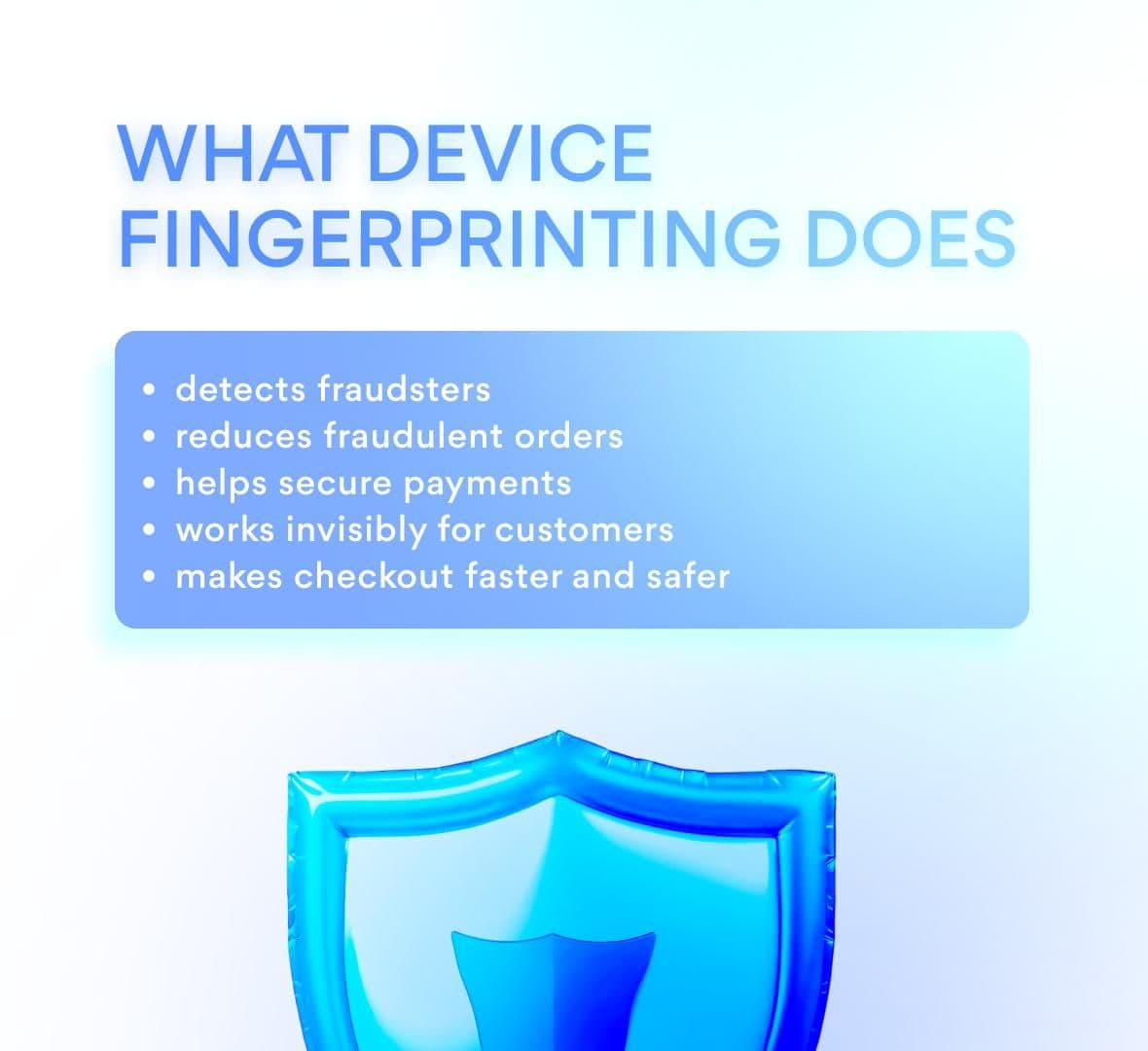
Device fingerprinting is a technology that identifies a user’s device based on a combination of technical parameters. In simple terms, the system creates a unique digital profile of a device using dozens of characteristics.
These may include:
- operating system version
- browser type
- screen resolution
- device language
- IP address
- time zone
- processor and graphics chip characteristics
- network parameters
All these signals are combined into a unique device identifier. The key advantage of this technology is that it works invisibly in the background and does not require additional actions from the user during payment.
Why this technology is becoming critical
Today, fraudsters are capable of:
- intercepting OTP codes
- using stolen card data
- creating fake accounts
- bypassing basic security checks
As a result, traditional authentication methods are no longer sufficient.
This is why banks and fintech companies are moving toward real-time risk assessment models. Systems must now analyze not only the user’s password but also the behavior and reliability of the device used for the transaction.
If a device has previously been involved in suspicious activity, the system can automatically increase the level of verification or block the transaction entirely.
New RBI requirements in 2026
Starting in 2026, new RBI requirements focused on risk-based authentication are being introduced in India.
This means payment systems must dynamically evaluate the risk level of each transaction rather than relying solely on standard verification methods.
Companies that begin implementing such solutions early will be able to adapt more quickly to changing market requirements.
Device fingerprinting and biometrics are not the same
Many people confuse device fingerprinting with biometric authentication, but these are completely different technologies. Biometrics verify the identity of a person — for example, through fingerprints or Face ID. Device fingerprinting analyzes the device itself.
In modern security systems, these technologies work together:
- biometrics verify the user
- device fingerprinting evaluates device trustworthiness and transaction risk
How device fingerprinting helps fight fraud
For Indian e-commerce, fraudulent orders and payment abuse remain major problems.
For example:
- creation of multiple fake accounts
- abuse of promo codes
- cash on delivery fraud
- repeated orders from the same device under different names
Device fingerprinting helps detect such schemes before payment confirmation. If the system identifies a suspicious device or repeated behavioral patterns, the transaction automatically receives a high-risk status.
Balancing security and customer convenience
One of the biggest advantages of device fingerprinting is that it works in the background. Users do not need to complete additional verification steps during every purchase. This is especially important for e-commerce, where every extra second in the checkout process affects conversion rates. Studies show that complicated authentication processes remain one of the leading causes of cart abandonment. If a system can automatically recognize trusted devices, the payment experience becomes faster and smoother.
Data privacy concerns
As device analysis technologies evolve, attention to personal data protection is also increasing. In India, this has become especially relevant following the implementation of the Digital Personal Data Protection Act. Companies using device fingerprinting must inform users that technical device data is being collected for security and fraud prevention purposes. That is why businesses must not only implement security technologies but also maintain transparent data processing policies. Device fingerprinting is becoming one of the most important tools for securing digital payments in India in 2026. With rising fraud levels and stricter RBI requirements, businesses can no longer rely solely on OTP codes and traditional authentication methods. Modern security systems must analyze not only the user but also the device used for the transaction. This approach makes it possible to combine strong security, seamless payment experiences, and compliance with evolving market requirements.
With solutions from Einpays, businesses can build safer, faster, and more advanced payment processes adapted to the demands of the modern digital economy.
Other News
What Is a Cryptocurrency Swap and how to start exchanging without unnecessary complications?
27.05.2026
What Is a Cryptocurrency Swap and how to start exchanging without unnecessary complications?
The cryptocurrency market is evolving rapidly, and with it, the ways of managing digital assets are changing as well. Today, users no longer need to go through complex and costly chains of operations to exchange one coin for another. A faster and more flexible tool has replaced the traditional model — the cryptocurrency swap. A swap allows users to instantly exchange digital assets within the blockchain ecosystem, without involving banks or converting funds into fiat currency. This makes the process not only faster but also significantly more cost-effective. For users, this opens up new opportunities: participating in various projects, optimizing investment portfolios, and reacting quickly to market changes.
Sales through personal branding: how experts and online businesses can accept more payments
20.05.2026
Sales through personal branding: how experts and online businesses can accept more payments
In 2026, personal branding has become one of the most powerful tools for online sales. People no longer buy only a product or service — they buy trust, reputation, and expertise. That is why freelancers, consultants, digital specialists, owners of online schools, iGaming projects, high-risk platforms, and e-commerce businesses are increasingly building sales around their personal identity or company brand. However, even a strong personal brand does not guarantee stable revenue if a business lacks a well-structured sales system and convenient payment infrastructure. A user may become interested in a product but abandon the purchase due to complicated payment flows, slow transaction confirmation, or the absence of familiar payment methods. Today, it is not enough for online businesses to simply attract an audience — they must also turn attention into fast and secure payments.
Do you need to pay GST for online sales in India? Rules, limits, and understanding TCS
13.05.2026
Do you need to pay GST for online sales in India? Rules, limits, and understanding TCS
India’s e-commerce market is growing rapidly. But alongside the rise of online sales comes a key question: do businesses need to pay GST when selling goods and services online? The short answer: it depends on the sales model. If a seller operates through a marketplace, GST registration is usually required from the very beginning. If sales are made through a personal website, standard turnover thresholds may apply: ₹40 lakh for goods and ₹20 lakh for services in most Indian states. These thresholds are confirmed by GST Council guidelines and GST tax reference materials. For online businesses, this is far more than a formality. GST affects marketplace access, tax calculations, TCS deductions, refunds, reporting obligations, and overall cash flow. That is why sellers should understand the rules before making their first sale.


Connect global

Sales
Business Development Manager
Partnership
Account Manager
Business Development Manager
Connect global
Sales
Partnership
Account Manager
Business Development Manager
Business Development Manager


Become a Partner
Do you want to become a partner
Your name
Fill the form to submit
Your Company name
Fill the form to submit
Your E-mail
Fill the form to submit
Countries
Fill the form to submit
Your phone number (Telegram)
Fill the form to submit
Web-site
Fill the form to submit
Contact person
Fill the form to submit
Business
Message