Important Notice: Beware of Scams Using the Name "EINPAYS/EINPAYZ"
We have recently discovered that fraudsters are misusing the name EINPAYS/EINPAYZ to deceive traders, service providers, and other individuals by collecting payments through unauthorized channels.
- If you receive any communication claiming to be from EINPAYS/EINPAYZ and asking for payments or sensitive details, we strongly urge you to verify its authenticity first.
- All the official contact details can be found on https://einpays.com or https://einpayz.com
Verify Before You Act:
To confirm whether a communication is genuinely from EINPAYS/EINPAYZ, please email us at [email protected] before making any payments or sharing any personal information.



Become a Partner
Do you want to become a partner
Your name
Fill the form to submit
Your Company name
Fill the form to submit
Your E-mail
Fill the form to submit
Countries
Fill the form to submit
Your phone number (Telegram)
Fill the form to submit
Web-site
Fill the form to submit
Contact person
Fill the form to submit
Business

Message
Fill the form to submit
Become a Partner
Do you want to become a partner
Your name
Fill the form to submit
Your Company name
Fill the form to submit
Your E-mail
Fill the form to submit
Countries
Fill the form to submit
Your phone number (Telegram)
Fill the form to submit
Web-site
Fill the form to submit
Contact person
Fill the form to submit
Business
Message
Fill the form to submit
What is a payment aggregator? How it works, its types and features
- 2026-01-28
In the modern digital business landscape, customers expect convenience, while companies demand stability and transparency in financial transactions. In this environment, payment aggregators come to the rescue as universal solutions that simplify working with online payments. A payment aggregator is a type of financial intermediary between your business and your customers. It enables the acceptance of payments through various channels, simplifies integration, and ensures data security. By using a single aggregator, companies can focus on developing their business instead of managing numerous separate banking connections and payment systems.
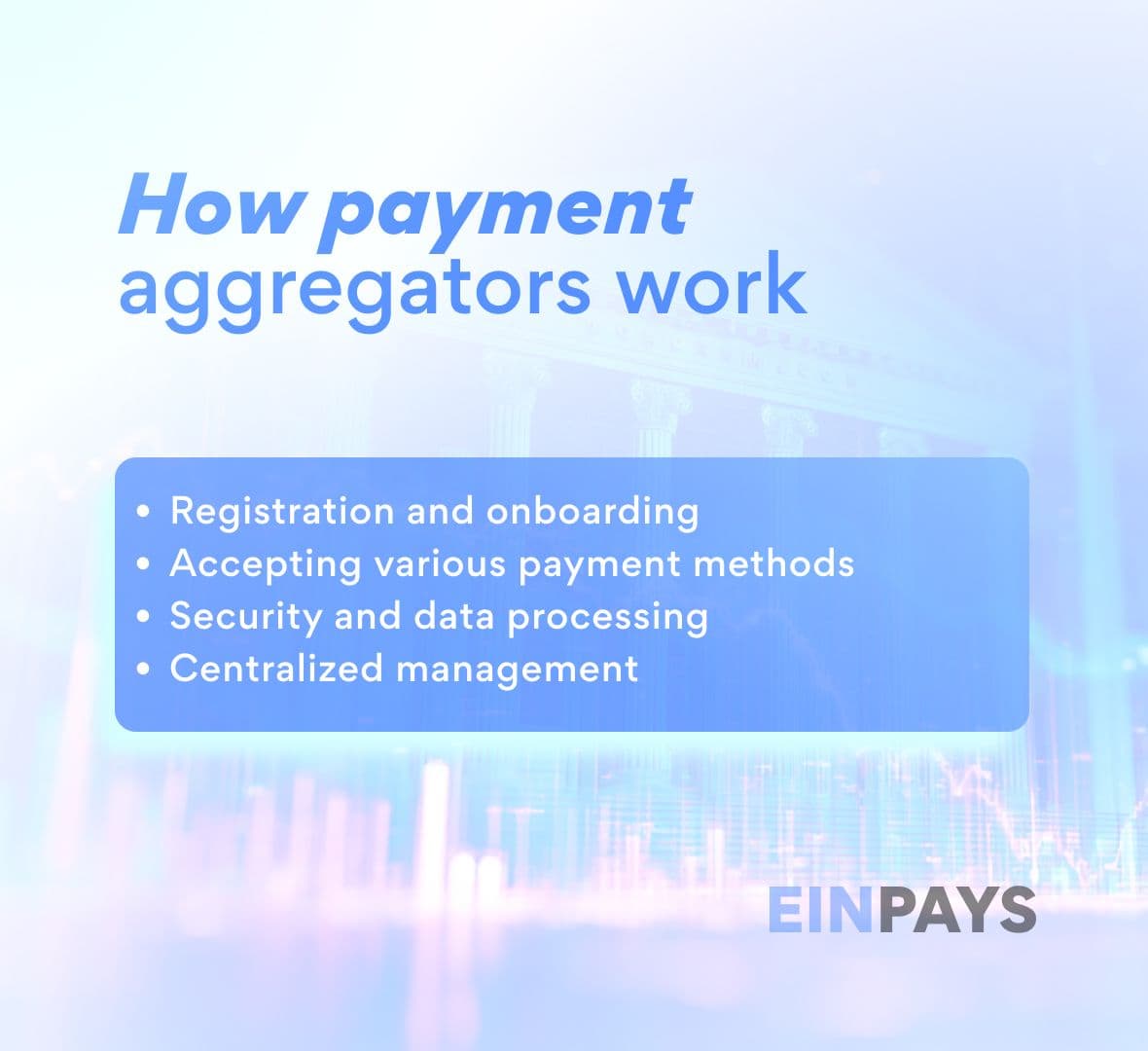
How payment aggregators work
The principle behind a payment aggregator's operation is relatively straightforward, although it's backed by a complex technical infrastructure.
1. Registration and onboarding It all starts with creating a merchant account with the aggregator. After registration, your company is ready to accept payments without needing multiple banking integrations.
2. Accepting various payment methods The aggregator consolidates all payment channels into one platform. These can include credit and debit cards, bank transfers, e-wallets, cardless EMI, BNPL (Buy Now, Pay Later), UPI, and e-mandates. This allows customers to choose their preferred payment method, while businesses achieve maximum customer reach.
3. Security and data processing One of the key aspects of an aggregator's operation is security. All transactions are protected using modern encryption methods, and customers' personal data is processed in compliance with strict standards. This gives companies confidence in data integrity and helps prevent fraud.
4. Centralized management All operations are displayed on a unified dashboard, simplifying payment monitoring, control, and analysis. Businesses can track sales in real-time, identify key performance indicators, and make data-driven decisions.
Main types of payment aggregators
Although all aggregators perform similar functions, there are distinctions among them:
- For small and medium-sized businesses (SMBs): Provide simple integration, minimize costs, and reduce the administrative burden on the company.
- For startups: Allow for quick setup of payment acceptance, enabling a focus on product development and customer acquisition.
- For e-commerce platforms: Integrate various payment methods into a unified system, enhancing customer convenience and improving service quality.
- For subscription services: Optimize recurring billing and integrate with membership management systems.
- For marketplaces and multi-vendor platforms: Centralize payment management between different vendors and ensure secure transactions.
Payment aggregator vs. payment gateway: what's the difference?
Payment aggregators are often compared to payment gateways, but there are fundamental differences between them, primarily in functionality and the scope of tasks they address.
A payment gateway focuses on transmitting payment data. Its main task is to provide a secure connection between an online store and an acquiring bank. This tool essentially acts as a technical intermediary, allowing payments to be accepted through a specific bank. Typically, a gateway works with one acquirer, and its key advantage for a business is relatively simple integration and potentially lower transaction fees for high-volume processing.
A payment aggregator solves a broader range of tasks. It takes on comprehensive management of all payment processes, consolidating various payment methods into one system. An aggregator interacts with multiple banks and payment services simultaneously, providing businesses with a single space for accepting, processing, and controlling transactions. Among its key advantages are quick registration, an expanded choice of payment methods for customers, and a unified management dashboard that simplifies payment monitoring and analytics.
Advantages of using a payment aggregator
Using an aggregator offers businesses several clear advantages:
- Instant setup: Forget the need to connect to multiple banks. Quick start-up allows you to immediately accept payments in new markets.
- Diversity of payment methods: Customers can choose a convenient payment channel—cards, e-wallets, online banking, BNPL, and others.
- Cost reduction: Aggregators negotiate with banks and financial institutions, securing favorable terms for businesses.
- Enhanced security: Tokenization, fraud prevention, and data protection allow you to focus on business growth without being distracted by technical complexities.
- Simplicity of management: A unified control and analytics dashboard simplifies working with transactions, improves the customer experience, and saves employees' time.
Payment aggregators are an indispensable tool for modern business. They consolidate diverse payment methods, ensure transaction security, simplify integration, and allow companies to focus on development and customer service.
For small and medium-sized companies, startups, e-commerce platforms, and marketplaces, aggregators become the financial management hub, saving resources and unlocking new opportunities. With Einpays, your payments become maximally convenient for you and your customers.
Other News
Pos terminals: how card limits work
25.02.2026
Pos terminals: how card limits work
In the modern world, cards have become an integral part of everyday financial transactions. Purchases, bill payments, cash withdrawals — we do most of these using a debit or credit card. But behind every convenient transaction, there are rules and restrictions designed to protect your money. One such restriction is POS terminal limits. A POS terminal is a device in stores and other retail outlets that accepts card payments. It processes the card's data, verifies the PIN, and communicates with your bank to complete the transaction. But did you know that behind every such transaction, there's a maximum amount you can spend or withdraw? This is precisely what POS terminal limits manage.
SiGMA Eurasia Dubai 2026!
18.02.2026
SiGMA Eurasia Dubai 2026!
From February 9th to 11th, the Einpays team took part in SiGMA Eurasia Dubai 2026, one of the largest events in the region for high technology and online gaming. The exhibition was an excellent opportunity to explore the latest industry trends, discuss innovative solutions, and establish new professional contacts from around the world.

Payment failed
11.02.2026
Payment failed: What to do?
"Payment Failed": analyzing the main reasons and rescuing your transaction That familiar feeling when you're sure about your card, but see a "Declined" or "Payment Denied" notification? Don't rush to panic or blame the service. In 99% of cases, the problem is solved in a couple of minutes. The EinPays team knows from firsthand experience what is most often behind the error. Let's figure it out: why your online payment failed and what to do in each situation.


Connect global

Sales
Business Development Manager
Partnership
Account Manager
Business Development Manager
Connect global
Sales
Partnership
Account Manager
Business Development Manager
Business Development Manager


Become a Partner
Do you want to become a partner
Your name
Fill the form to submit
Your Company name
Fill the form to submit
Your E-mail
Fill the form to submit
Countries
Fill the form to submit
Your phone number (Telegram)
Fill the form to submit
Web-site
Fill the form to submit
Contact person
Fill the form to submit
Business
Message