Important Notice: Beware of Scams Using the Name "EINPAYS/EINPAYZ"
We have recently discovered that fraudsters are misusing the name EINPAYS/EINPAYZ to deceive traders, service providers, and other individuals by collecting payments through unauthorized channels.
- If you receive any communication claiming to be from EINPAYS/EINPAYZ and asking for payments or sensitive details, we strongly urge you to verify its authenticity first.
- All the official contact details can be found on https://einpays.com or https://einpayz.com
Verify Before You Act:
To confirm whether a communication is genuinely from EINPAYS/EINPAYZ, please email us at [email protected] before making any payments or sharing any personal information.



Become a Partner
Do you want to become a partner
Your name
Fill the form to submit
Your Company name
Fill the form to submit
Your E-mail
Fill the form to submit
Countries
Fill the form to submit
Your phone number (Telegram)
Fill the form to submit
Web-site
Fill the form to submit
Contact person
Fill the form to submit
Business

Message
Fill the form to submit
Become a Partner
Do you want to become a partner
Your name
Fill the form to submit
Your Company name
Fill the form to submit
Your E-mail
Fill the form to submit
Countries
Fill the form to submit
Your phone number (Telegram)
Fill the form to submit
Web-site
Fill the form to submit
Contact person
Fill the form to submit
Business
Message
Fill the form to submit
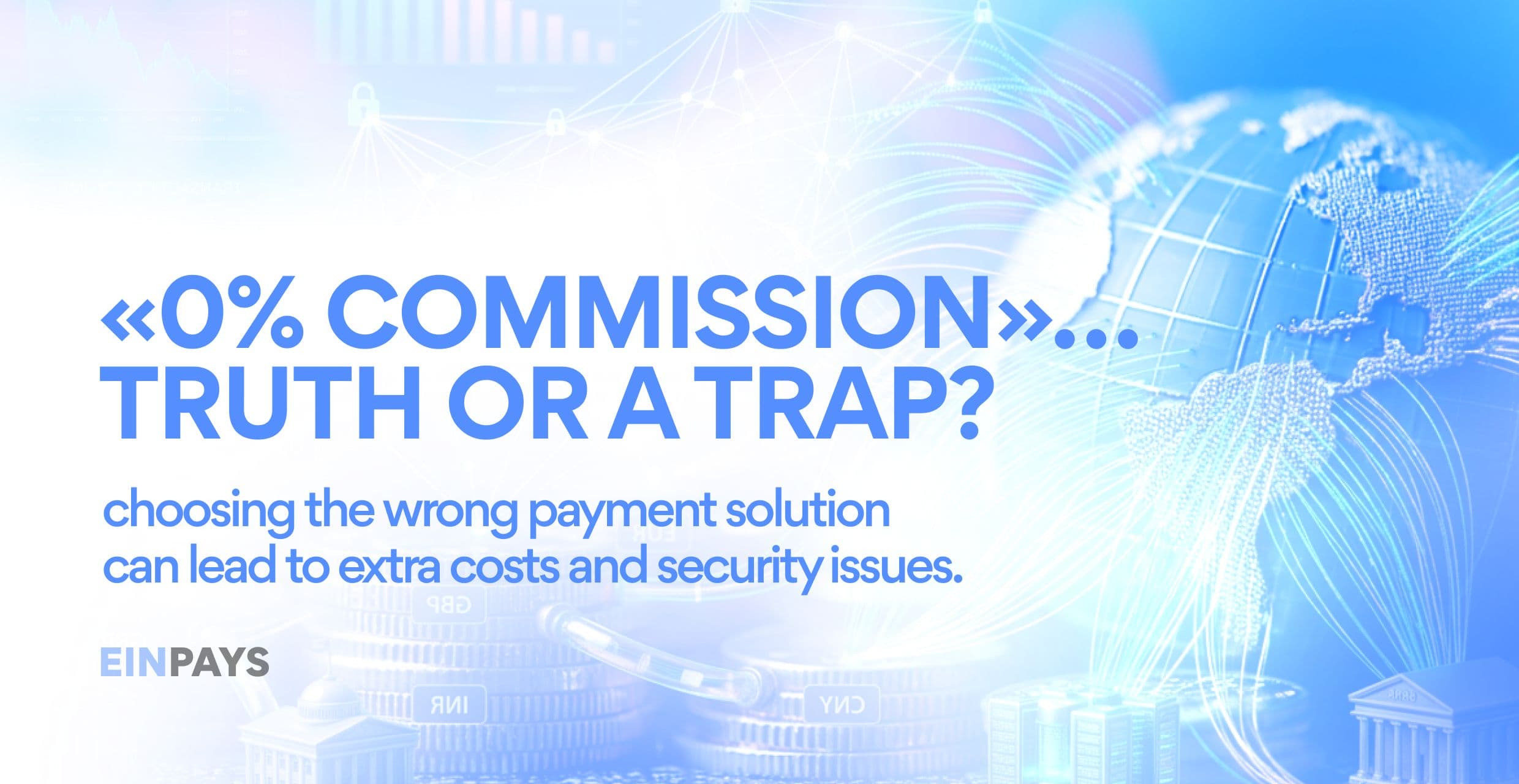
What crypto payment gateways won’t tell you: 5 red flags for businesses in 2026
- 2026-07-22
By 2026, accepting cryptocurrency is no longer just a trend—it has become a business standard. According to industry research, more than 80% of merchants have already integrated or plan to integrate digital assets into their payment systems. However, there's one major challenge: choosing the wrong crypto payment gateway can cost your business more than not accepting cryptocurrency at all. Hidden fees, weeks of integration, and lost customers are just some of the consequences of making the wrong choice. Here are the five most common—and most expensive—mistakes businesses make when choosing a crypto payment gateway.
No transaction screening
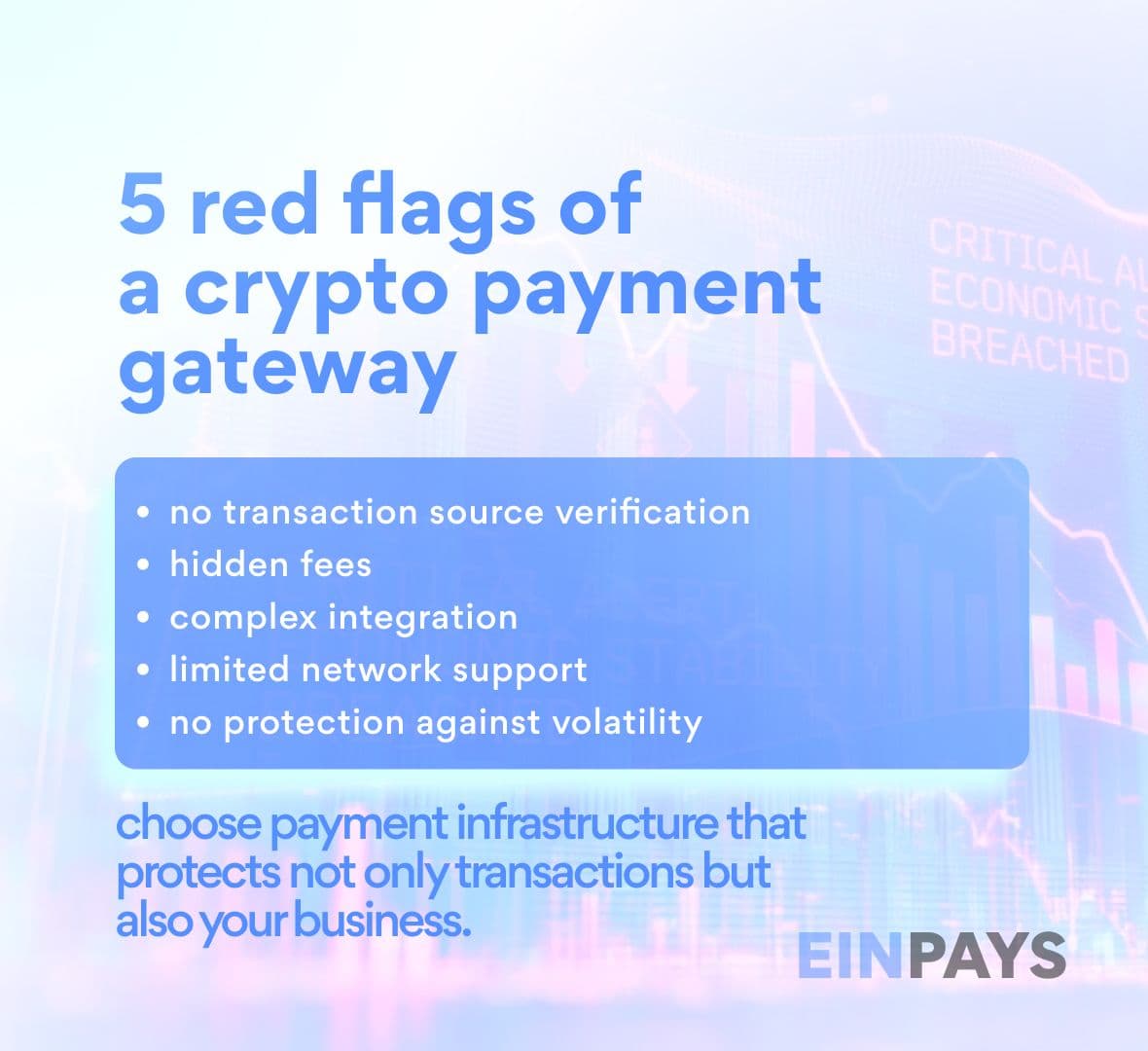
The privacy of cryptocurrencies does not eliminate risk. If your payment gateway doesn't verify the source of funds, your business may unknowingly accept payments linked to fraud, money laundering, or sanctioned wallet addresses.
Modern payment solutions use real-time blockchain transaction screening to reduce compliance risks without making the payment process more complicated. This helps businesses meet regulatory requirements while protecting them from potential financial and legal consequences.
Complicated integration
Low transaction fees don't always mean low implementation costs.
Some crypto payment gateways require weeks of developer work, complex API configuration, and extensive testing before they can go live. The longer the integration takes, the more expensive the project becomes—and the longer your business has to wait before offering customers a new payment option. A modern payment solution should offer fast onboarding, clear documentation, and ready-to-use integration tools that minimize development time.
"Zero fees" rarely mean zero costs
You've probably seen offers promising "0% transaction fees." It sounds perfect—but in the payments industry, nothing is truly free.
So how do these providers make money?
Hidden exchange rates. Instead of charging a transaction fee, they offer exchange rates that are 2–3% worse than the market rate. It may look like you're paying nothing, but you're actually losing money on every transaction.
High withdrawal fees. Deposits may be free, but when it's time to withdraw your funds, you're faced with unexpectedly high payout charges.
As a result, businesses often end up paying significantly more than they would with a provider that offers transparent pricing. When choosing a payment partner, don't focus solely on advertised fees. Evaluate the total cost of payment processing and look for a clear, transparent pricing model.
Limited blockchain and network support
If a payment gateway supports only a handful of cryptocurrencies or blockchain networks, some customers may face high network fees—or abandon their purchase altogether.
Today's users expect the flexibility to pay using multiple blockchain networks and stablecoins while keeping transaction costs low.
The broader the payment options available, the higher the payment completion rate and the lower the number of abandoned checkouts.
Ignoring volatility
Accepting cryptocurrency is only half the process. If incoming funds remain in volatile digital assets, their value can change dramatically within hours. Modern crypto payment solutions can automatically convert incoming payments into stablecoins, helping businesses reduce exposure to market volatility and make financial planning far more predictable.
In 2026, cryptocurrency payments are becoming an integral part of the digital economy. But success depends on much more than simply accepting digital assets—it depends on choosing the right payment infrastructure. Ignoring security, transparent pricing, ease of integration, network coverage, or volatility protection can lead to unnecessary costs, compliance risks, and lost customers.
Einpays helps businesses build a reliable cryptocurrency payment infrastructure by combining fast transaction processing, secure technology, seamless integration, and transparent pricing. The businesses that succeed won't simply be the ones that accept cryptocurrency—they'll be the ones that do it securely, efficiently, and with a long-term growth strategy in mind.
Other News
Crypto portfolio has dropped significantly: what to do step by step
26.08.2026
Crypto portfolio has dropped significantly: what to do step by step
A sharp crypto market decline can easily trigger the urge to do something immediately: sell everything or, on the contrary, buy even more. But the first thing to do after a major drop is not make a trade, but pause and analyze. It is important to understand the reason for the decline, assess the condition of your assets, and determine whether the current level of risk is consistent with your financial situation. In short: first, assess the current state of your portfolio, identify the reason for the decline, review your financial obligations, and only then decide whether to leave things unchanged, reduce risk, or gradually increase your position.
Why storing all your cryptocurrency in one place is risky
18.08.2026
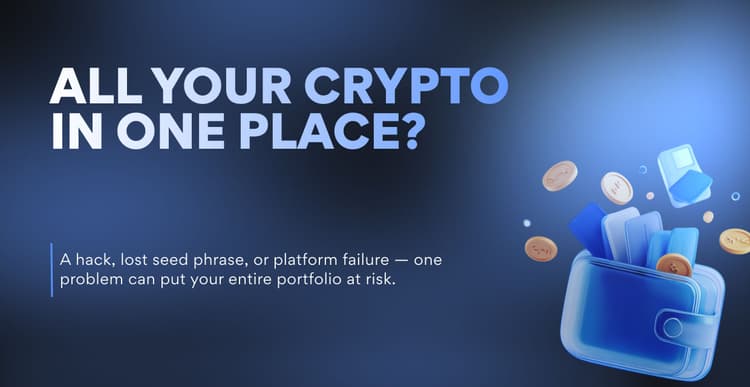
Why storing all your cryptocurrency in one place is risky
One account, one wallet, and one balance — it’s convenient. You don’t need to remember multiple addresses, switch between services, or search for a specific asset. But this convenience can become a serious risk. If all assets depend on one password, one seed phrase, one device, or one platform, any mistake can lead to losing access to the entire portfolio. The main issue is not a specific wallet or exchange — it is creating a single point of failure. Research shows that human error remains one of the biggest threats in the crypto industry: loss of access, transaction mistakes, and unsafe data storage are among the most common reasons for asset losses. At the same time, the number of cryptocurrency users has already exceeded 500 million people, making reliable payment infrastructure a critical part of the digital economy.
Subscription payment challenges in India: how global companies can adapt their payment processes
12.08.2026
Subscription payment challenges in India: how global companies can adapt their payment processes
India is one of the fastest-growing subscription economies. More than 900 million internet users, rapid growth in OTT, SaaS, EdTech, and D2C brands make this market incredibly attractive for global companies. But there’s one problem. What works in the US or Europe doesn’t necessarily work in India. Low credit card usage, the dominance of UPI, strict Reserve Bank of India (RBI) requirements, and a fragmented payment ecosystem make subscription billing a real challenge.


Connect global

Sales
Business Development Manager
Partnership
Account Manager
Business Development Manager
Connect global
Sales
Partnership
Account Manager
Business Development Manager
Business Development Manager


Become a Partner
Do you want to become a partner
Your name
Fill the form to submit
Your Company name
Fill the form to submit
Your E-mail
Fill the form to submit
Countries
Fill the form to submit
Your phone number (Telegram)
Fill the form to submit
Web-site
Fill the form to submit
Contact person
Fill the form to submit
Business
Message