Important Notice: Beware of Scams Using the Name "EINPAYS/EINPAYZ"
We have recently discovered that fraudsters are misusing the name EINPAYS/EINPAYZ to deceive traders, service providers, and other individuals by collecting payments through unauthorized channels.
- If you receive any communication claiming to be from EINPAYS/EINPAYZ and asking for payments or sensitive details, we strongly urge you to verify its authenticity first.
- All the official contact details can be found on https://einpays.com or https://einpayz.com
Verify Before You Act:
To confirm whether a communication is genuinely from EINPAYS/EINPAYZ, please email us at [email protected] before making any payments or sharing any personal information.



Become a Partner
Do you want to become a partner
Your name
Fill the form to submit
Your Company name
Fill the form to submit
Your E-mail
Fill the form to submit
Countries
Fill the form to submit
Your phone number (Telegram)
Fill the form to submit
Web-site
Fill the form to submit
Contact person
Fill the form to submit
Business

Message
Fill the form to submit
Become a Partner
Do you want to become a partner
Your name
Fill the form to submit
Your Company name
Fill the form to submit
Your E-mail
Fill the form to submit
Countries
Fill the form to submit
Your phone number (Telegram)
Fill the form to submit
Web-site
Fill the form to submit
Contact person
Fill the form to submit
Business
Message
Fill the form to submit
Low today, higher tomorrow: why iGaming tax rates change over time
- 2026-07-29
When a new iGaming market is launched, conditions for operators usually look attractive: low tax rates, simplified licensing, and the opportunity to quickly establish a position in the market. This strategy helps governments attract legal operators, investments, and move players away from the illegal sector. However, over time, regulations begin to change: control increases, new requirements appear, and the tax burden grows. For operators, it is important to consider not only current conditions but also possible future changes in order to maintain profitability and competitiveness.
Why new markets start with low taxes
At the beginning, the main goal of regulators is to create a stable industry and attract major market players. High taxes can reduce companies’ interest in entering a new region, so governments often offer more favorable conditions for early participants.
This helps accelerate market development: new technologies, investments, and infrastructure begin to emerge. However, low tax rates are usually a temporary growth strategy rather than a permanent model.
Once the market becomes mature and starts generating stable revenue, conditions are gradually reviewed.
Why taxes increase
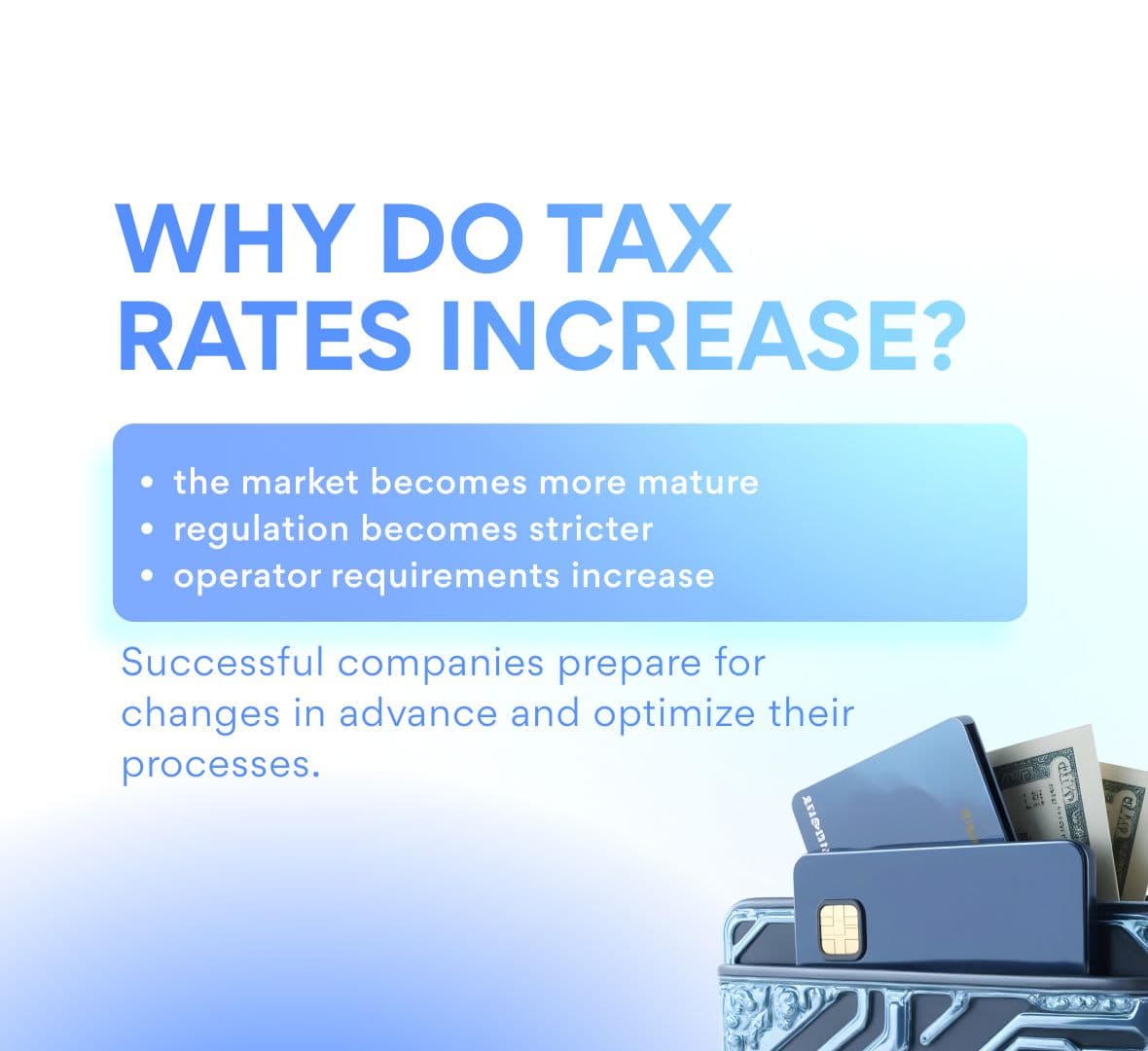
Tax increases rarely happen unexpectedly. They are usually the result of several factors. One of them is the growing focus on social responsibility and player protection. As iGaming develops, governments introduce additional requirements for control and security. Budget policy also plays an important role. When the industry becomes a stable source of revenue, governments begin to view it as an additional financial resource. At the same time, operators’ compliance costs increase: reporting, transaction monitoring, user control, and implementation of new systems all require additional investments. Therefore, it is not only the tax rate that changes, but also the overall cost of running a business.
How rising taxes affect operators
An increase in tax pressure directly impacts companies’ financial models.
The main consequences include:
- reduced profits and margins;
- fewer opportunities for large bonus programs;
- the need to manage marketing expenses more efficiently;
- higher compliance costs;
- increased competition between operators. In these conditions, companies that optimize their processes in advance and use technology to improve efficiency gain a competitive advantage.
How to identify possible changes in advance
Potential tax increases can often be predicted before official announcements.
Possible signals include: Changes in the regulatory approach. If discussions about player protection and stricter control become more frequent, this may indicate future regulatory changes. New fees and mandatory payments. Sometimes additional business costs appear not through tax rate increases, but through new requirements and obligations. Stricter reporting requirements. Expanding control measures and increasing the amount of mandatory data often become part of a broader regulatory process.
Operators need to analyze these trends in advance and prepare their business models for possible changes.
How to prepare for new conditions
The sustainability of an iGaming business depends on its ability to adapt quickly. Companies need to regularly evaluate their financial models, find ways to optimize costs, and improve internal processes.
Payment infrastructure plays a particularly important role. Fast, secure, and reliable payments help improve user experience and reduce operational challenges.
Einpays solutions allow businesses to organize convenient payment processing while ensuring fast and reliable financial operations. This helps operators focus on product development and growth management even in a constantly changing market environment.
The iGaming industry shows that attractive launch conditions rarely remain unchanged. Low tax rates help attract the first market participants, but long-term success depends on how well a company is prepared for future changes.
Other News
Crypto portfolio has dropped significantly: what to do step by step
26.08.2026
Crypto portfolio has dropped significantly: what to do step by step
A sharp crypto market decline can easily trigger the urge to do something immediately: sell everything or, on the contrary, buy even more. But the first thing to do after a major drop is not make a trade, but pause and analyze. It is important to understand the reason for the decline, assess the condition of your assets, and determine whether the current level of risk is consistent with your financial situation. In short: first, assess the current state of your portfolio, identify the reason for the decline, review your financial obligations, and only then decide whether to leave things unchanged, reduce risk, or gradually increase your position.
Why storing all your cryptocurrency in one place is risky
18.08.2026
Why storing all your cryptocurrency in one place is risky
One account, one wallet, and one balance — it’s convenient. You don’t need to remember multiple addresses, switch between services, or search for a specific asset. But this convenience can become a serious risk. If all assets depend on one password, one seed phrase, one device, or one platform, any mistake can lead to losing access to the entire portfolio. The main issue is not a specific wallet or exchange — it is creating a single point of failure. Research shows that human error remains one of the biggest threats in the crypto industry: loss of access, transaction mistakes, and unsafe data storage are among the most common reasons for asset losses. At the same time, the number of cryptocurrency users has already exceeded 500 million people, making reliable payment infrastructure a critical part of the digital economy.
Subscription payment challenges in India: how global companies can adapt their payment processes
12.08.2026
Subscription payment challenges in India: how global companies can adapt their payment processes
India is one of the fastest-growing subscription economies. More than 900 million internet users, rapid growth in OTT, SaaS, EdTech, and D2C brands make this market incredibly attractive for global companies. But there’s one problem. What works in the US or Europe doesn’t necessarily work in India. Low credit card usage, the dominance of UPI, strict Reserve Bank of India (RBI) requirements, and a fragmented payment ecosystem make subscription billing a real challenge.


Connect global

Sales
Business Development Manager
Partnership
Account Manager
Business Development Manager
Connect global
Sales
Partnership
Account Manager
Business Development Manager
Business Development Manager


Become a Partner
Do you want to become a partner
Your name
Fill the form to submit
Your Company name
Fill the form to submit
Your E-mail
Fill the form to submit
Countries
Fill the form to submit
Your phone number (Telegram)
Fill the form to submit
Web-site
Fill the form to submit
Contact person
Fill the form to submit
Business
Message