Important Notice: Beware of Scams Using the Name "EINPAYS/EINPAYZ"
We have recently discovered that fraudsters are misusing the name EINPAYS/EINPAYZ to deceive traders, service providers, and other individuals by collecting payments through unauthorized channels.
- If you receive any communication claiming to be from EINPAYS/EINPAYZ and asking for payments or sensitive details, we strongly urge you to verify its authenticity first.
- All the official contact details can be found on https://einpays.com or https://einpayz.com
Verify Before You Act:
To confirm whether a communication is genuinely from EINPAYS/EINPAYZ, please email us at [email protected] before making any payments or sharing any personal information.



Become a Partner
Do you want to become a partner
Your name
Fill the form to submit
Your Company name
Fill the form to submit
Your E-mail
Fill the form to submit
Countries
Fill the form to submit
Your phone number (Telegram)
Fill the form to submit
Web-site
Fill the form to submit
Contact person
Fill the form to submit
Business

Message
Fill the form to submit
Become a Partner
Do you want to become a partner
Your name
Fill the form to submit
Your Company name
Fill the form to submit
Your E-mail
Fill the form to submit
Countries
Fill the form to submit
Your phone number (Telegram)
Fill the form to submit
Web-site
Fill the form to submit
Contact person
Fill the form to submit
Business
Message
Fill the form to submit
How to optimize settlements for high-frequency betting: crypto APIs and stablecoins for iGaming
- 2026-08-05
15 minutes. That is exactly how long the break between halves lasts in esports matches. And during these 15 minutes, betting platforms face their highest load. Tens of thousands of users try to top up their balances at the same time, driven by the urgency to place a bet before the odds change. Betting lines update every second. Every delay costs money. Traditional payment systems struggle to handle this level of demand. Dynamic address generation, slow database requests, and unpredictable fees turn peak activity periods into points of revenue loss.
Why traditional payments fail during peak moments
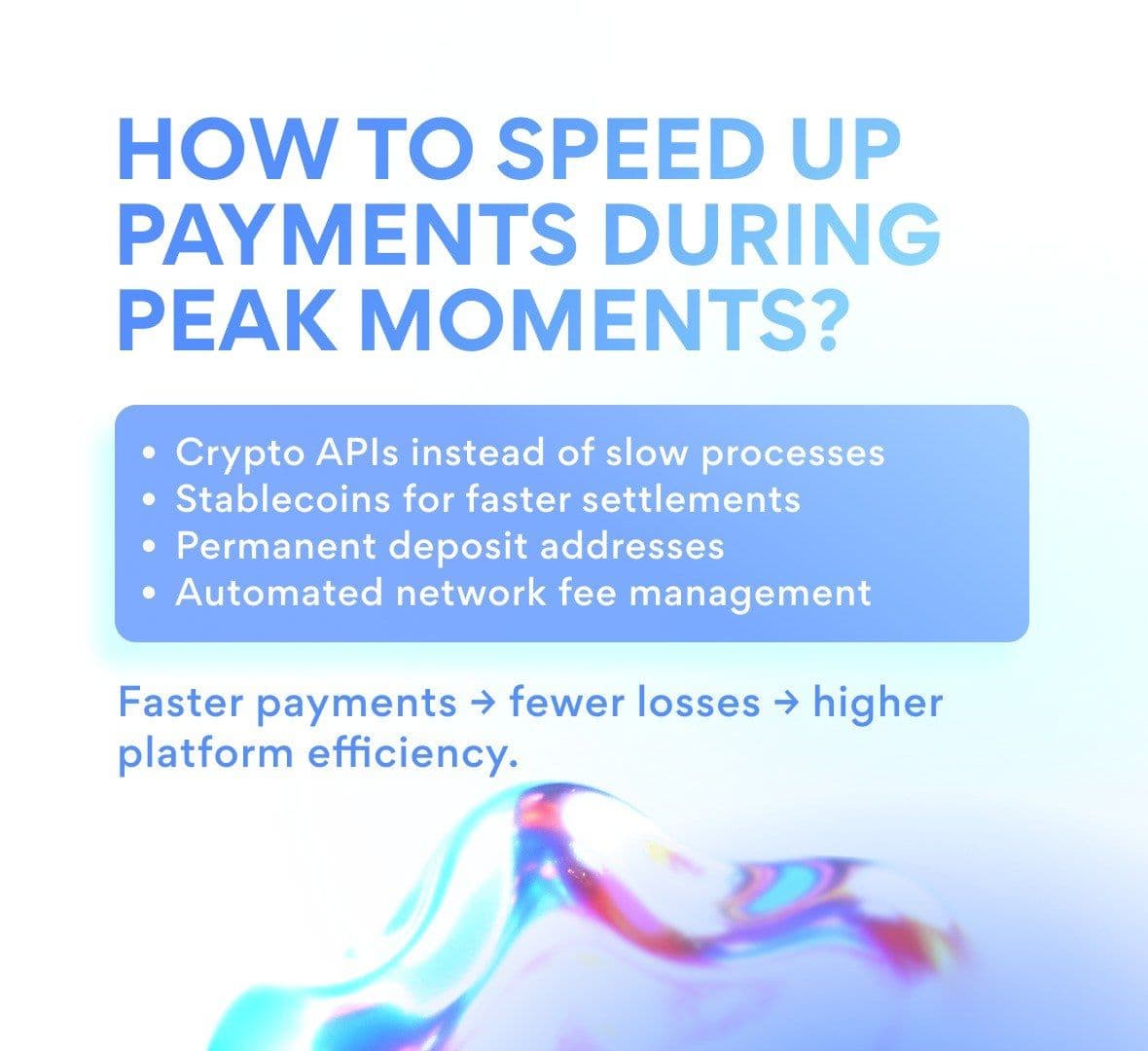
First, most payment plugins are built on outdated Web2 architecture. Every deposit request triggers the generation of a new temporary address and intensive database operations. Under normal conditions, this works. During peak periods — it does not. When tens of thousands of users try to fund their accounts simultaneously, backend databases become overloaded with requests. API response times increase. The result: up to 30% of users abandon the deposit process before even sending funds. In addition, in live betting, even a few seconds of delay can lead to customer loss. Another challenge is transaction fees. When thousands of microtransactions occur simultaneously, network fees can rise sharply and reduce platform profitability.
This is especially relevant on the TRON network, where without optimization, each transaction can cost 13–14 TRX, creating additional expenses for both businesses and players.
Stablecoins as the foundation of modern settlements
Crypto payments in iGaming are gradually moving from an experimental tool to a full-scale financial infrastructure.
Stablecoins play a particularly important role — digital assets whose value is linked to stable currencies. They allow operators to:
- process international settlements faster;
- reduce the impact of cryptocurrency volatility;
- simplify operations with users from different regions;
- ensure more predictable fund management.
Permanent deposit addresses
Instead of generating new addresses for every payment, modern crypto APIs link a static address to each player's profile.
How it works
When a payment request is created, the system checks: Does this user already have an assigned address?
- Yes — the existing address is instantly returned.
- No — a new address is created and linked to the user's profile.
Result: zero waiting time. The player scans a QR code or copies the address from their account and sends the payment.
Benefits One address across multiple networks EVM networks can use a single address for each user. No confusion. No risk of losing assets. Better user experience The address remains unchanged. Users can save it in their wallet. Deposits can be completed within seconds. Instant synchronization Once a transaction is confirmed, a webhook updates the balance on the gaming server immediately. No delays.
Automating network fee management
High-frequency betting generates thousands of microtransactions. Without proper fee management, each transaction reduces the platform's margin. ** The TRON challenge** USDT-TRC20 is one of the most widely used standards for high-frequency settlements. However, each transaction consumes approximately 13–14 TRX in network resources. Across thousands of transactions, this becomes a significant operational expense.
Solution: automated energy rental Operators can purchase energy service packages, and the system automatically applies discounts to transactions. This provides:
- predictable costs instead of volatile network fees;
- more than 50% reduction in transaction expenses;
- better protection of margins on microtransactions.
The future of high-frequency betting payments
High-frequency betting requires next-generation payment infrastructure. Traditional solutions often cannot handle sudden traffic spikes and the expectations of modern players.
The use of crypto APIs, stablecoins, and automated payment processes allows operators to build faster, more reliable, and scalable payment systems. Einpays helps businesses create payment infrastructure designed for the speed and scale of the digital economy.
Other News
Crypto portfolio has dropped significantly: what to do step by step
26.08.2026
Crypto portfolio has dropped significantly: what to do step by step
A sharp crypto market decline can easily trigger the urge to do something immediately: sell everything or, on the contrary, buy even more. But the first thing to do after a major drop is not make a trade, but pause and analyze. It is important to understand the reason for the decline, assess the condition of your assets, and determine whether the current level of risk is consistent with your financial situation. In short: first, assess the current state of your portfolio, identify the reason for the decline, review your financial obligations, and only then decide whether to leave things unchanged, reduce risk, or gradually increase your position.
Why storing all your cryptocurrency in one place is risky
18.08.2026
Why storing all your cryptocurrency in one place is risky
One account, one wallet, and one balance — it’s convenient. You don’t need to remember multiple addresses, switch between services, or search for a specific asset. But this convenience can become a serious risk. If all assets depend on one password, one seed phrase, one device, or one platform, any mistake can lead to losing access to the entire portfolio. The main issue is not a specific wallet or exchange — it is creating a single point of failure. Research shows that human error remains one of the biggest threats in the crypto industry: loss of access, transaction mistakes, and unsafe data storage are among the most common reasons for asset losses. At the same time, the number of cryptocurrency users has already exceeded 500 million people, making reliable payment infrastructure a critical part of the digital economy.
Subscription payment challenges in India: how global companies can adapt their payment processes
12.08.2026
Subscription payment challenges in India: how global companies can adapt their payment processes
India is one of the fastest-growing subscription economies. More than 900 million internet users, rapid growth in OTT, SaaS, EdTech, and D2C brands make this market incredibly attractive for global companies. But there’s one problem. What works in the US or Europe doesn’t necessarily work in India. Low credit card usage, the dominance of UPI, strict Reserve Bank of India (RBI) requirements, and a fragmented payment ecosystem make subscription billing a real challenge.


Connect global

Sales
Business Development Manager
Partnership
Account Manager
Business Development Manager
Connect global
Sales
Partnership
Account Manager
Business Development Manager
Business Development Manager


Become a Partner
Do you want to become a partner
Your name
Fill the form to submit
Your Company name
Fill the form to submit
Your E-mail
Fill the form to submit
Countries
Fill the form to submit
Your phone number (Telegram)
Fill the form to submit
Web-site
Fill the form to submit
Contact person
Fill the form to submit
Business
Message